


Why hydroseeding is worth it — the honest case for investing in your lawn
If you have been researching hydroseeding you have probably already figured out that it costs more than throwing seed on the ground and less than installing sod. You have a general sense of what it does. What you might still be working through is whether the investment is actually justified — whether the result is meaningfully better than the cheaper alternative and whether the premium over broadcast seeding produces enough additional value to make the difference worth spending.
This guide makes the honest case for hydroseeding as a lawn investment. Not promotional language about amazing results but the specific real reasons why the investment produces value that the alternatives cannot match — and the honest acknowledgment of the situations where it might not be the right choice.
The case starts with what the alternatives actually produce
The honest case for hydroseeding cannot be made in isolation — it requires an honest look at what the alternatives actually produce in Texas conditions because the value of hydroseeding is relative to what you get without it.
Broadcast seeding on a bare yard in Texas conditions — particularly on new construction lots with compacted clay and minimal topsoil — produces results that most homeowners who have tried it describe the same way. Patchy. Thin in some sections. Requiring multiple attempts before acceptable coverage was achieved. The total cost of two or three broadcast seeding attempts that each partially failed often exceeds the cost of a single quality hydroseeding application that would have established reliably the first time.
This is not an argument that broadcast seeding never works. It works in ideal conditions on well-prepared soil with consistent irrigation and favorable weather. North Texas conditions are frequently not ideal — the heat the clay the rainfall intensity and the challenging surfaces of new construction lots combine to make the conditions that produce reliable broadcast seeding results the exception rather than the rule.
The comparison that makes the hydroseeding investment case is not hydroseeding versus a single successful broadcast seeding attempt. It is hydroseeding versus the realistic total cost of the broadcast seeding attempts that most DFW homeowners actually experience before achieving an acceptable result.
What hydroseeding actually buys that broadcast seeding does not
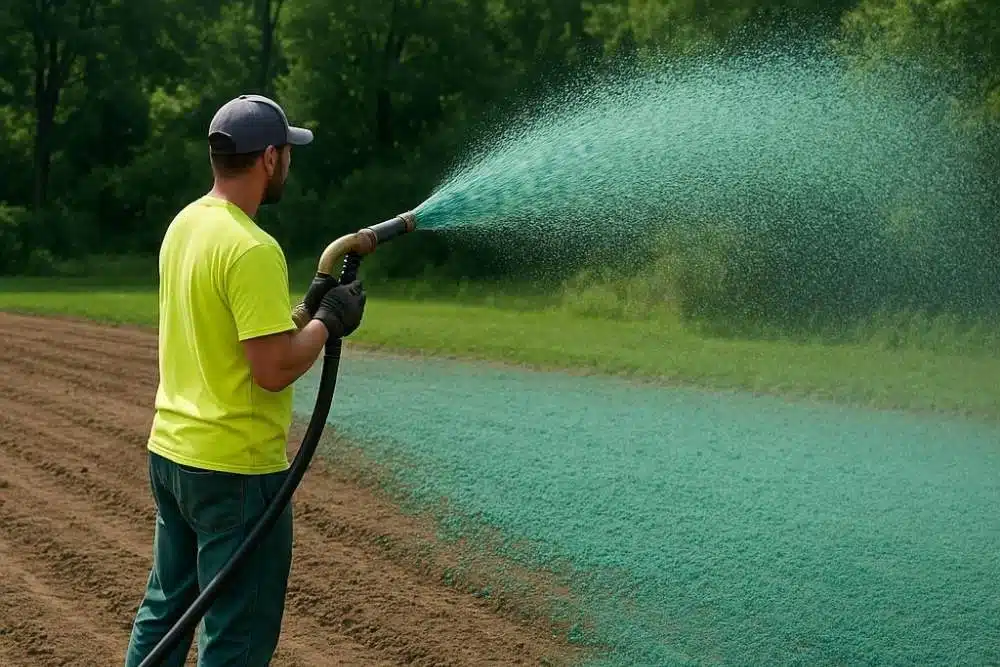
The specific thing that hydroseeding provides beyond broadcast seeding is the protective slurry layer — the mulch that retains moisture around the seed moderates surface temperature holds the seed in place against wind and rainfall displacement and creates the consistent germination environment that Texas conditions consistently undermine for bare seed on the surface.
That protection has a specific value in Texas — it is the difference between germination rates that produce the consistent coverage homeowners are hoping for and germination rates that produce the patchy coverage that requires touchup and re-investment.
A quality hydroseeding application on a properly prepared North Texas lot produces germination across the full seeded area in five to seven days and solid coverage in three to four weeks. This result does not happen with broadcast seeding on the same lot under the same Texas conditions with anything close to the same consistency.
The investment in hydroseeding is essentially the investment in reliable first-attempt establishment — the premium that makes the difference between a lawn that succeeds and one that requires repeated investment to achieve the same result.
The compound return that makes the investment worthwhile
The financial case for hydroseeding is strongest when viewed as a multi-year investment rather than a one-time cost.
A lawn established correctly through hydroseeding on a properly prepared surface with committed first-year management produces compounding returns through every subsequent growing season. Root depth built in year one makes year two easier. Turf density developed through proper establishment makes weed control less intensive from year two onward. Soil structure improvement that begins with proper preparation and continues through annual aeration compounds through year three year four and beyond.
The properly established lawn requires less ongoing management investment in subsequent years than a poorly established one — lower irrigation costs from deeper roots that access moisture more efficiently lower weed control costs from the competitive density that suppresses weed establishment lower renovation costs from the resilience that prevents the seasonal failures that require repeated reseeding.
The total cost of ownership over a five to ten year horizon for a properly established hydroseeded lawn is lower than the total cost of a poorly established lawn that requires the repeated interventions that inadequate establishment produces — even when the upfront cost of the quality establishment is higher than the alternatives.
The property value argument
Curb appeal has measurable impact on property value and the lawn is the single most visible element of curb appeal. Real estate research consistently finds that well-maintained lawns contribute to faster sales at higher prices compared to properties with neglected outdoor spaces.
For homeowners who intend to sell the property at any point the lawn investment has a direct financial return through the property value it supports. A thick green established front lawn contributes to the first impression that affects every subsequent perception of the property — from the initial drive-by assessment to the price that buyers are willing to offer.
The return on hydroseeding investment from a property value perspective is not theoretical — it is the real observable difference between the property that looks maintained and the one that does not from the street.
The quality of life argument
Property value and financial returns are legitimate arguments for hydroseeding but they are not the primary reason most homeowners invest in their lawn. The primary reason is the quality of life difference between a yard that looks and functions the way you want it to and one that does not.
A thick established backyard lawn is where kids play where family spends outdoor time where summer evenings happen. A bare or patchy yard is where none of those things happen comfortably — the space that gets avoided rather than used because it does not feel like the outdoor environment the household imagined when they bought the home.
The investment in a quality lawn establishment is an investment in years of outdoor living quality that accumulates through every summer the lawn is healthy and used. That return is not on a balance sheet but it is real and it compounds with every season the established lawn enables outdoor living that an unestablished yard would not.
The honest situation where hydroseeding might not be worth it
Making the honest case for hydroseeding requires acknowledging the situations where the investment might not be the right choice.
Very small areas where the minimum cost of professional hydroseeding equipment makes the per-square-foot economics unfavorable compared to broadcast seeding or sod. A few hundred square feet of bare ground in an otherwise established lawn may be more economically addressed through targeted broadcast overseeding than through professional hydroseeding mobilization.
Situations with a hard immediate timeline where instant coverage is genuinely required. A home closing in five days with a required lawn. An HOA compliance deadline that cannot accommodate a four-week establishment period. When the timeline is the primary and non-negotiable constraint sod solves the problem that hydroseeding cannot.
Very limited budgets where the upfront cost difference between hydroseeding and broadcast seeding represents a genuine financial hardship. In these situations the honest advice is that broadcast seeding with realistic expectations of multiple attempts and patient management is better than no attempt — while acknowledging that the total cost of multiple failed attempts may eventually equal or exceed the hydroseeding investment that would have worked the first time.
Outside of these specific situations the investment case for hydroseeding is strong for most Texas homeowners with bare or significantly thin yards who can accommodate the establishment timeline.
The timing argument: why now costs less than later
The final element of the honest case for hydroseeding is timing — specifically the compounding cost of delay.
Every season of bare or inadequate lawn coverage is a season of living with the outcome you are trying to avoid. Every failed broadcast seeding attempt that precedes the hydroseeding application adds to the total investment that the lawn required before it delivered the result. Every spring that passes with the project still on the to-do list is a spring growing season that the established lawn did not get — root development that did not happen irrigation efficiency that did not improve density that did not develop.
The homeowner who hydroseeds in spring of year one arrives at the end of year two with a deeply rooted established lawn. The homeowner who waits until spring of year three after two seasons of broadcast seeding attempts that did not fully deliver arrives at the end of year four with the same established lawn — but paid for three spring establishment seasons and two years of inadequate coverage to get there.
The investment in quality establishment now is less expensive in total than the investment in repeated inadequate attempts followed eventually by quality establishment when the patience for the alternatives runs out.
The bottom line on whether hydroseeding is worth it
For most Texas homeowners with bare or significantly thin yards who want a quality established lawn and can accommodate a four to six week establishment period the answer is yes — hydroseeding is worth the investment. It produces more reliable first-attempt establishment than broadcast seeding in Texas conditions. It costs meaningfully less than sod. It creates the foundation that compounds into lower maintenance costs and better performance through subsequent growing seasons. And it delivers the lawn that makes the property look better feel better and function better as an outdoor living space for as long as the homeowner lives there.
That is the honest case. Not a guarantee that everything goes perfectly or that the investment is right for every situation. But the specific realistic reasons why for most DFW homeowners who have been thinking about getting the lawn right the right time to make the investment is this season rather than the next one.

Ready to find out what a quality hydroseeding application would cost for your specific property?
Fox Hydroseeding LLC provides free on-site estimates and gives every homeowner an honest assessment of what their yard needs and what it will cost before any commitment is made. Every estimate is handled personally by the owner.
Get Your Free Estimate → foxhydroseeding.com/contact
Bring Your Property to Life With Expert Hydroseeding
Find Us On


Email address

Phone Number

