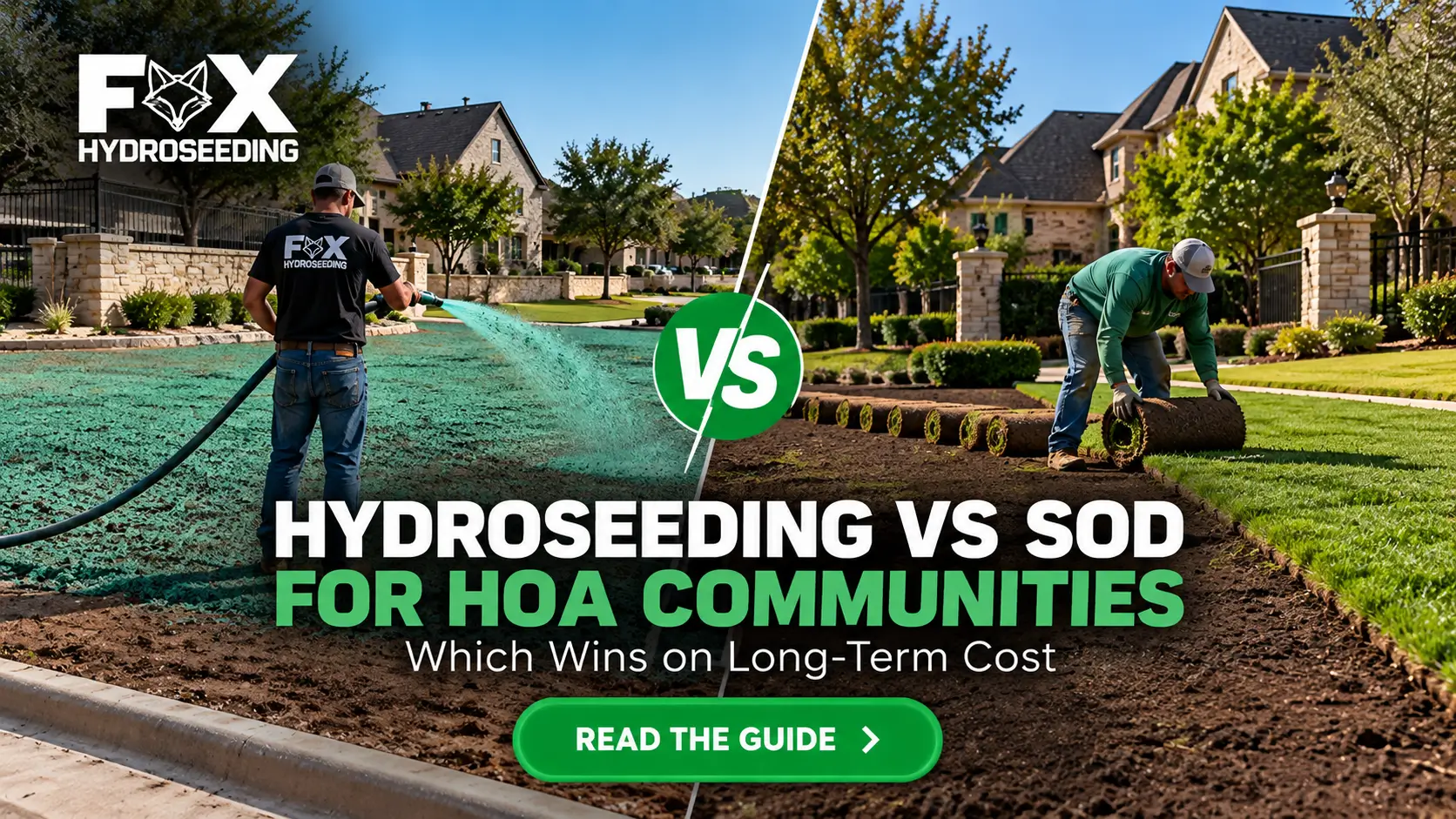
Hydroseeding vs Sod for HOA Communities: Which Wins on Long-Term Cost
HOA communities often manage much more grass than a typical homeowner. Entryways, common areas, walking paths, detention areas, clubhouses, medians, parks, and vacant community spaces can add up to thousands of square feet or several acres.
That makes the choice between hydroseeding and sod more than a landscaping preference. It becomes a budgeting and property-management decision.
When comparing hydroseeding vs sod for HOA projects, hydroseeding often has the advantage in upfront installation cost across large areas. Sod provides immediate grass coverage, but material and installation costs can increase quickly as square footage grows.
Long-term value, however, depends on more than the initial invoice. Watering, soil preparation, establishment time, repair needs, appearance expectations, and future maintenance should all be considered.
Fox Hydroseeding works with commercial properties, developments, large lots, and community spaces throughout North Texas, helping clients select an approach based on actual site conditions.
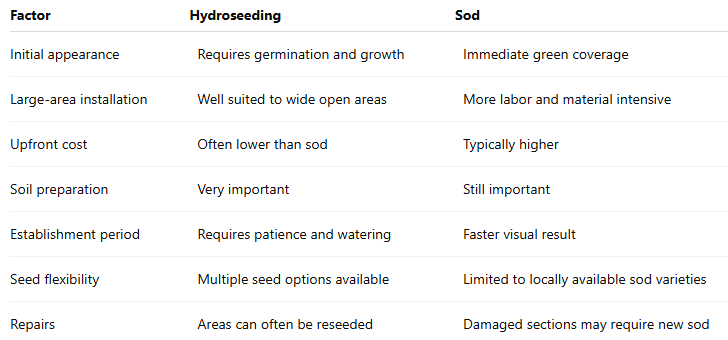
Hydroseeding vs Sod for HOA Properties at a Glance
Both options can establish permanent lawns when installed and maintained correctly.
The biggest differences are how the grass is installed, how quickly the property looks finished, and how much the initial project may cost.
For a broader homeowner-level comparison, Fox Hydroseeding also explains hydroseeding vs sod in North Texas.
Why HOA Lawn Cost Comparison in Texas Is Different
An HOA lawn cost comparison in Texas should consider scale.
Installing sod on a 2,000-square-foot entrance is very different from installing it across multiple acres of common space.
Material Costs Add Up Quickly
Sod arrives as established turf that has already been grown, harvested, transported, and prepared for installation.
The larger the community area, the more material and handling are required.
Hydroseeding uses a wet application containing seed, mulch, fertilizer, water, and selected additives. For large spaces, the application process can cover ground efficiently.
This is one reason commercial hydroseeding services can make sense for HOA common areas and larger developments.
Labor Should Be Included in the Comparison
Boards should compare complete installed costs rather than only the price of grass material.
Sod installation may involve unloading, carrying, positioning, cutting, fitting, and rolling individual sections.
Hydroseeding is applied mechanically across a prepared surface, which can be efficient when the property includes wide or open spaces.
Does Hydroseeding Always Cost Less Long Term?
Not automatically.
Hydroseeding can reduce initial installation costs compared with sod on many large projects, but long-term cost depends on how successfully the lawn is established and maintained.
Watering During Establishment
A newly hydroseeded lawn needs consistent moisture during germination.
If an HOA has poor irrigation coverage, broken sprinkler zones, or no practical watering plan, establishment may become more difficult.
Sod also requires significant watering after installation, so boards should not assume instant green turf eliminates irrigation needs.
Ongoing Maintenance
Once fully established, long-term mowing, fertilization, weed control, and irrigation depend mainly on the turfgrass being grown and how the property is maintained.
A properly established hydroseeded lawn does not remain a different type of lawn forever. It becomes established turf.
That means much of the long-term maintenance cost is influenced by grass variety and HOA maintenance practices rather than whether the grass originally arrived as seed or sod.
Hydroseeding Homeowners Association Common Areas
Hydroseeding homeowners association properties can work particularly well where communities have large spaces that do not require an instantly finished appearance.
Potential areas include:
- Parks and recreation spaces
- Roadside common areas
- Walking trail surroundings
- Large entrance areas
- Clubhouse grounds
- Open green spaces
- Detention and drainage areas
- Areas disturbed during construction
- New community development phases
The larger and more open the area, the more important it becomes to compare installation methods based on total project requirements.
When Sod May Be Worth the Higher Initial Cost
Hydroseeding is not automatically the right answer for every square foot of an HOA property.
Some highly visible or heavily used areas may benefit from immediate turf coverage.
Community Entrances
A new development preparing for home sales may want a finished appearance at the main entrance immediately.
High-Traffic Areas
Certain spaces cannot remain protected from foot traffic long enough for seed to establish properly.
Small Repairs
If an HOA needs to replace a very small damaged section, purchasing and installing a few pieces of matching sod may be simpler than mobilizing a hydroseeding project.
For some communities, a combination approach makes sense. Sod can be used in small high-visibility areas while hydroseeding covers larger open spaces.
Soil Preparation Matters With Either Choice
Poor soil does not become good soil simply because sod is placed over it.
Likewise, hydroseed should not be applied over heavily compacted, rough, or unsuitable ground without addressing the underlying conditions.
Prepare the Ground First
HOA projects may require:
- Surface weed removal
- Fine grading
- Soil loosening
- Construction debris cleanup
- Drainage corrections
- Topsoil improvement
Fox Hydroseeding offers skid steer soil preparation for properties that need grading and seedbed preparation before hydroseeding.
Check Soil Quality
New developments can sometimes have compacted or disturbed soils after months of construction activity.
Where needed, topsoil and soil improvement can help create a better growing environment before grass establishment.
Skipping preparation to reduce the initial budget can create more expensive repair work later.
Consider Repair Costs Across the Community
Long-term HOA budgeting should include future lawn repairs.
Construction work, utility repairs, vehicle damage, drought stress, drainage projects, and irrigation problems can all create bare areas.
Hydroseeding can be useful when larger disturbed sections need to be re-established.
For a community with ongoing construction phases, this flexibility can be valuable because landscaping work may continue as homes, amenities, roads, or utilities are completed.
Appearance Timeline Can Affect the Decision
Sod wins when immediate appearance is the top priority.
Once installed, the property looks green right away, although the roots still need time to establish into the underlying soil.
Hydroseeding requires germination and growth before the area develops into a full lawn.
That difference matters for:
- Grand openings
- Model-home areas
- Community events
- Highly visible entrances
- Developer turnover deadlines
For less time-sensitive common areas, the HOA may decide that waiting for establishment is worth the potential installation savings.
How HOAs Can Compare Quotes More Accurately
Boards and property managers should avoid comparing a hydroseeding quote with a sod quote based on price alone.
Ask what each proposal includes.
Review These Items
Check for:
- Total square footage or acreage
- Soil preparation
- Grass type
- Fertilizer and mulch
- Grading requirements
- Topsoil
- Irrigation responsibilities
- Erosion-control materials
- Cleanup
- Establishment instructions
If the project includes several acres, reviewing the Fox Hydroseeding guide to hydroseeding cost in North Texas can also help during early budgeting.
Which Option Makes More Sense for Your HOA?
For large North Texas common areas where budget efficiency matters and the community can accommodate an establishment period, hydroseeding often provides a strong cost advantage over sod.
Sod can still make sense where immediate finished appearance or rapid surface coverage is worth paying more upfront.
The best solution does not have to be all or nothing.
An HOA may use sod around a clubhouse or main entrance while choosing hydroseeding for acres of open common space.
Fox Hydroseeding can evaluate property size, soil, irrigation, slopes, site access, and project timing before recommending an application strategy.
HOA boards and property managers can review completed Fox Hydroseeding projects and customer experiences through the Fox Hydroseeding Google Business Profile.
For an HOA community, new development, or large common-area project in North Texas, contact Fox Hydroseeding for a free estimate.
Frequently Asked Questions About Hydroseeding vs Sod for HOAs
Is hydroseeding cheaper than sod for an HOA?
Hydroseeding typically has a lower upfront installation cost than sod for large areas. The actual savings depend on square footage, preparation, seed type, access, and other project requirements.
Is hydroseeding suitable for HOA common areas?
Yes. Parks, open spaces, clubhouse grounds, roadside areas, entrances, and other community areas can be suitable for hydroseeding when soil preparation and watering are properly planned.
Does hydroseed require more maintenance than sod?
During establishment, hydroseed requires careful watering and protection from traffic. Once the grass is fully established, regular maintenance is primarily determined by turf type and site conditions.
Which looks better immediately, hydroseeding or sod?
Sod provides an immediate green appearance. Hydroseeding needs time to germinate and fill in, making sod more suitable when instant visual impact is essential.
Can an HOA use both hydroseeding and sod?
Yes. A community can use sod in smaller, high-visibility areas and hydroseeding across larger common spaces where immediate turf coverage is less important.
Is hydroseeding good for new housing developments?
Yes. Hydroseeding can be used for common areas, open spaces, disturbed construction ground, commercial sections, and other parts of new developments.
How can our HOA get an accurate comparison?
Measure the actual areas involved and evaluate soil condition, grading, irrigation, grass selection, timeline, and appearance requirements. Fox Hydroseeding can then provide a site-specific hydroseeding estimate for comparison with a complete sod proposal.

Bring Your Property to Life With Expert Hydroseeding
Find Us On


