

Hydroseeding vs artificial grass — an honest comparison for homeowners who want to make the right call
Artificial grass has become a genuine competitor in the Texas lawn market over the past decade. The pitch is compelling — no watering no mowing no brown patches in summer no dead spots from pet urine and a yard that looks the same in August as it does in April. For homeowners who have struggled with lawn establishment in Texas heat the appeal is understandable. But the comparison between artificial grass and hydroseeded natural lawn involves trade-offs that go well beyond the surface-level convenience argument and most homeowners who look carefully at the full picture arrive at a different conclusion than the artificial turf sales conversation suggests.
This guide gives you an honest comparison of both options across the factors that matter most for Texas homeowners — cost installation performance longevity environmental impact and the real-world experience of living with each choice.
The cost comparison: upfront versus lifetime
Artificial grass has a significantly higher upfront cost than hydroseeding for most residential applications. The material cost of quality artificial turf combined with the base preparation and installation labor required for a proper artificial grass installation produces a per-square-foot cost that is substantially higher than hydroseeding for the same area.
Hydroseeding including any necessary site preparation is significantly less expensive per square foot than a quality artificial grass installation for most standard residential lot sizes in the DFW market. On a typical new construction lot the total cost difference between the two options can be substantial — representing a meaningful financial decision rather than a minor convenience trade-off.
The lifetime cost comparison shifts somewhat from the upfront comparison because artificial grass has no ongoing water cost and minimal mowing cost after installation while natural grass requires ongoing irrigation and maintenance expenses. For homeowners in areas with high water costs or significant water restrictions the reduced irrigation requirement of artificial grass has real ongoing financial value.
However the lifetime cost calculation for artificial grass must also include replacement cost. Quality artificial turf has a functional lifespan of typically eight to fifteen years depending on the product quality the installation quality and the use intensity it experiences. At the end of that lifespan the artificial turf needs to be removed and replaced — a significant cost event that natural grass lawns maintained correctly do not face. A properly established natural grass lawn maintained appropriately can last the full life of the property without replacement.
The honest lifetime cost comparison for most residential applications favors natural grass hydroseeding — particularly when the replacement cycle cost of artificial turf is factored into the comparison alongside the upfront installation premium.
Performance: what each option actually delivers
Artificial grass delivers a consistent appearance year-round that does not vary with seasons drought conditions or maintenance effort. The surface looks the same in February as in July and requires no watering fertilizing or mowing to maintain that appearance. For homeowners whose primary goal is a consistently presentable yard with minimal ongoing effort the performance promise of artificial grass is real.
The performance limitations of artificial grass become apparent in a Texas climate context. Artificial turf surfaces heat significantly in direct sunlight — surface temperatures on artificial grass in Texas summer sun can reach levels that are uncomfortable or even painful to walk on barefoot and that make the surface unsuitable for children or pets during the hottest parts of summer days. This heat retention is a characteristic of the synthetic material that cannot be eliminated through product selection — it is a physical property of dark-colored synthetic fibers absorbing and retaining solar energy.
Drainage performance of artificial grass depends heavily on installation quality. A properly installed artificial grass system with appropriate base preparation and drainage infrastructure handles rainfall adequately. An improperly installed system can develop drainage problems that create standing water odor and surface degradation over time.
Pet waste management is more complex on artificial grass than natural grass marketing often suggests. While urine does drain through the surface the ammonia and bacteria associated with pet waste accumulate in the infill material over time creating odor that requires periodic cleaning treatments to manage. Dog waste must be removed manually as it does on natural grass but the surface does not benefit from the natural biological processes that break down organic waste in a living soil environment.
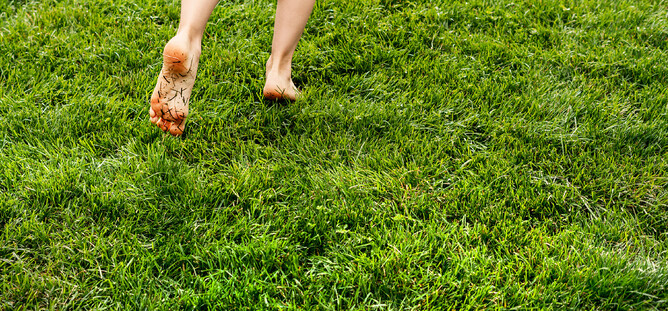
Natural grass established through quality hydroseeding delivers the performance of a living lawn — it responds to the environment breathes provides cooling through evapotranspiration supports soil biology and provides the soft natural surface that children and pets can use comfortably through the full range of temperatures. During Texas summers a well-watered natural grass lawn is significantly cooler than an adjacent artificial turf surface — a meaningful comfort and safety difference for families using the outdoor space.
Environmental considerations
The environmental comparison between artificial grass and natural grass is more nuanced than either side of the debate typically presents but the fundamental environmental characteristics of each option are worth understanding honestly.
Artificial grass is a petroleum-based product. Its manufacture involves the same environmental footprint as other synthetic polymer products and the product itself is not biodegradable — at the end of its useful life artificial turf typically goes to landfill because recycling infrastructure for the material is limited and expensive. The infill materials commonly used in artificial grass systems raise additional environmental concerns depending on the specific product.
Natural grass established through hydroseeding is a living ecosystem component. It produces oxygen captures carbon supports soil biology provides habitat for insects and ground-dwelling organisms and participates in the water cycle through evapotranspiration. The water required to maintain natural grass is a genuine environmental cost — significant in a drought-prone region like North Texas — but drought-tolerant grass varieties and efficient irrigation management reduce that cost meaningfully.
The environmental trade-off is essentially water use and maintenance inputs for natural grass versus petroleum product manufacture and landfill disposal for artificial grass. Neither option is without environmental cost. For homeowners who weight these considerations in their decision choosing drought-tolerant native grass varieties through hydroseeding offers a path that minimizes the water cost while maintaining the ecological benefits of a living natural surface.
Longevity and what changes over time
Natural grass established through quality hydroseeding gets better with age when maintained correctly. The root system deepens through each growing season the soil biology improves as organic matter accumulates and the turf density increases as the lawn fills in and matures. A properly maintained natural grass lawn ten years after establishment is a stronger more resilient lawn than it was in year one.
Artificial grass ages in the opposite direction. The synthetic fibers degrade under UV exposure losing their color consistency and becoming increasingly matted and worn through traffic. The infill material compacts and redistributes over time affecting drainage performance and surface feel. The seams and edges that hold the installation together can fail creating visible irregularities that worsen over time. The product that looked like a lawn on installation day looks progressively less like one as the years pass.
The visual peak of a natural grass lawn is in its mature years. The visual peak of an artificial grass installation is on installation day.
The specific situations where artificial grass makes sense
Being honest about the situations where artificial grass is the right choice produces a more credible comparison than dismissing it entirely.
Areas with no natural sunlight — under very dense evergreen canopies or in completely shaded enclosed spaces where no grass variety can survive — are legitimate candidates for artificial grass when surface coverage is desired and the options are artificial turf or bare ground or hardscape.
Very small high-use areas where natural grass cannot establish quickly enough between heavy use events — a small dedicated dog run in a portion of the yard a small play area that gets extremely concentrated traffic — may be appropriate artificial grass applications when the use intensity genuinely exceeds what natural grass can recover from between sessions.
Homeowners with severe water restrictions who cannot provide adequate irrigation for natural grass establishment during a period when the yard needs immediate improvement may find artificial grass the only practical solution for achieving a presentable yard within the constraints of their specific situation.
Outside of these specific situations the performance cost and longevity comparison favors natural grass hydroseeding for most residential applications in the Texas market.
The bottom line on hydroseeding versus artificial grass
Artificial grass is a viable product that solves specific problems for specific situations. It is not the right choice for most residential lawns in Texas when the full cost performance longevity and environmental picture is honestly evaluated.
Hydroseeded natural grass costs significantly less upfront and over a lifetime when replacement cycles are factored in. It performs better in Texas summer heat from a surface temperature and livability standpoint. It improves with age rather than degrading. It supports the natural ecosystem of a living yard in ways that a synthetic surface cannot. And it delivers the lawn experience — the feel of real grass underfoot the cooling of summer irrigation the biological activity of a living soil system — that artificial turf approximates visually but cannot replicate in the ways that matter most to families using the space.
For homeowners who have been considering artificial grass as a solution to lawn establishment frustration the more direct answer is usually a properly executed hydroseeding application with quality site preparation appropriate grass selection and the right seasonal timing — not a synthetic surface that solves the maintenance problem by eliminating the lawn rather than establishing one.

Considering artificial grass but want to know if natural grass hydroseeding is the better option for your yard?
Fox Hydroseeding LLC gives honest assessments of every property and every situation — including the ones where we tell you that a different approach might serve you better. Every estimate is handled personally by the owner.
Get Your Free Estimate → foxhydroseeding.com/contact
Bring Your Property to Life With Expert Hydroseeding
Find Us On


Email address

Phone Number

