


Hydroseeding in dry conditions — how to get grass established when water is limited
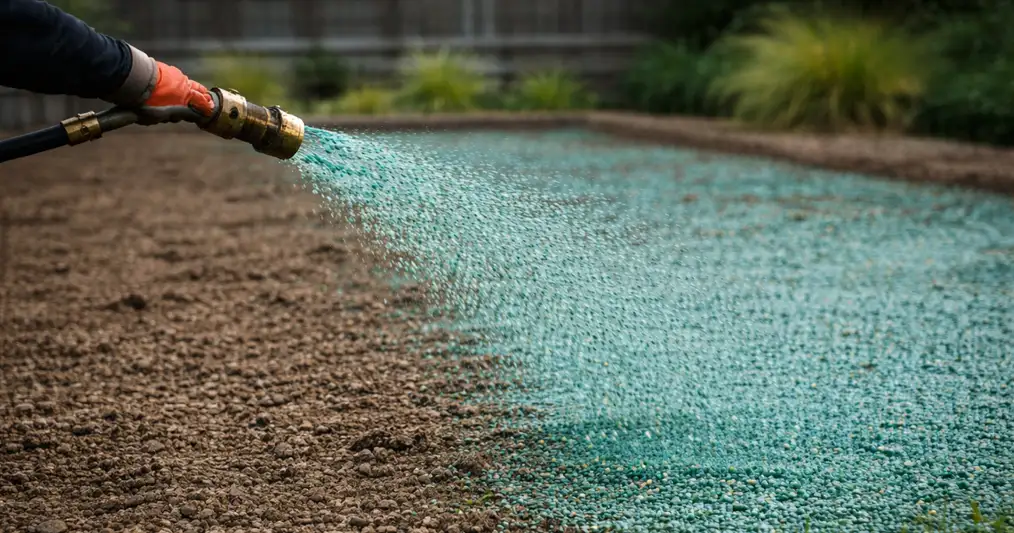
Water availability is one of the most practical constraints on lawn establishment in the DFW area. Municipal watering restrictions during drought periods limit how often and when outdoor irrigation can run. Properties without permanent irrigation systems depend on manual watering that requires time and attention. Rural and acreage properties may have limited water supply infrastructure that cannot support the intensive establishment watering that standard hydroseeding protocols call for.
For homeowners in any of these situations the question is not whether to establish a lawn — it is whether the water constraints they are working within make successful establishment realistic and what approach gives the best results given those constraints.
This guide covers every water-limited hydroseeding scenario what the honest tradeoffs look like and how to maximize establishment success when water availability is less than ideal.
Understanding what water does in hydroseeding establishment
Before adjusting for water constraints it helps to understand what the water actually does in the hydroseeding establishment process — because different parts of the water requirement are more negotiable than others.
During the germination window the first ten to fourteen days the primary water function is maintaining consistent moisture at the seed surface. The seed needs continuous moisture to complete the germination process once it has started. Germination does not pause and resume cleanly — seeds that begin the germination process and then dry out before completing it often lose viability. The twice to three-times daily watering schedule of standard establishment protocols exists specifically to maintain that continuous moisture against the evaporation demands of Texas conditions.
After germination the water function shifts to encouraging root development. Deep infrequent sessions that penetrate the soil profile motivate roots to develop downward rather than staying near the surface. This function is more forgiving of schedule variation than the germination window — a mature root system can tolerate longer intervals between waterings than a germinating seed can.
The most water-intensive and most critical window is the germination phase. This is where water constraints create the greatest risk to establishment success and where the adjustments described below are most important.
Scenario one: municipal watering restrictions
Many DFW municipalities implement watering restrictions during drought conditions or high-demand periods that limit outdoor irrigation to specific days and times. The practical question for a homeowner planning a hydroseeding project is whether the restricted schedule provides enough moisture delivery to support germination.
Most DFW municipal restriction schedules limit outdoor watering to two to three days per week — significantly less than the twice daily standard establishment protocol. Under standard summer conditions that restricted schedule is not sufficient to maintain the consistent seed surface moisture that germination requires during the first two weeks.
The adjustments that improve outcomes under watering restrictions are timing and season selection. Spring and fall applications have meaningfully lower evaporation demands than summer applications — the same restricted watering schedule that is inadequate in July may be adequate in April or October because the cooler temperatures and lower evaporation rates between sessions extend how long each watering session maintains adequate surface moisture.
Selecting a fall Fescue application when restrictions allow it produces better establishment under restricted watering conditions than a summer Bermuda application — both because fall evaporation demands are lower and because Fescue establishment in fall aligns with natural rainfall patterns that often supplement restricted irrigation schedules.
Contact your municipality to ask whether newly seeded lawn areas qualify for a variance or exemption from standard watering restriction schedules. Many DFW municipalities have provisions for new lawn establishment that recognize the specific watering needs of germinating seed — a temporary variance during the two-week germination window may be available that would not be applicable to routine lawn maintenance.
Scenario two: no permanent irrigation system
Establishing a lawn through manual watering — hose and sprinkler management without an automatic system — is possible but requires honest assessment of whether the management commitment is realistic for the homeowner's schedule and the specific conditions of the application.
The watering schedule for manual establishment in Texas summer conditions is three sessions per day for two weeks. Morning midday and early evening. Each session requires moving or adjusting sprinkler coverage across the full application area to ensure consistent moisture delivery. For a standard residential lot in a spring application this is a manageable if demanding two-week commitment. For a large lot in summer conditions it is a significant daily time investment that some homeowners can make and others realistically cannot.
The honest advice for homeowners without irrigation systems who are planning a hydroseeding project is to time the application for a season that reduces the manual watering burden. Spring applications benefit from natural rainfall support that reduces the supplemental watering demand — particularly in April when DFW spring rainfall is most consistent. Fall applications benefit from cooler temperatures that reduce evaporation and extend the time between sessions.
If a summer application is the only practical option consider the investment in temporary irrigation infrastructure before proceeding. Oscillating sprinklers on timers positioned across the application area are not a permanent irrigation system but they provide the automatic schedule reliability that manual watering cannot consistently deliver over a two-week period. The cost of temporary watering equipment is modest relative to the application investment it protects.
Scenario three: limited water supply on rural properties
Rural and acreage properties often present the most significant water supply constraints for hydroseeding establishment. Municipal water connections may not exist. Well capacity may be limited. Water storage tanks may provide finite supply that needs to be managed carefully through the establishment period.
For rural property hydroseeding the most effective water conservation approach is grass selection — choosing varieties that minimize the total establishment water demand and then minimize the ongoing irrigation requirement once established.
Buffalograss and native grass mixes are the most appropriate choices for rural Texas properties with limited water supply. Both are genuinely drought-adapted once established — requiring minimal to no supplemental irrigation through normal North Texas years after the root system has developed. The establishment period still requires consistent moisture but the total water investment per square foot is lower because the establishment happens in the cooler soil temperatures of late spring or fall that reduce evaporation demands rather than in the peak summer conditions that maximize water need per session.
The timing alignment for minimal water use rural establishment is late spring Buffalograss seeding — May in most DFW years when soil temperatures are in the optimal range but temperatures have not yet reached the peak evaporation conditions of July and August. Natural spring rainfall reduces the supplemental water demand during the establishment period and the grass's deep-rooting nature means the water investment produces the longest-lasting drought independence of any establishment option available.
Water truck delivery is a practical option for rural properties without adequate on-site water supply for establishment watering. Coordinating water delivery timing with the establishment watering schedule — scheduling deliveries to coincide with the refilling need of storage tanks or portable irrigation units — provides the establishment water supply that on-site infrastructure cannot support.
Scenario four: high-efficiency establishment under any water constraint
Regardless of the specific water constraint the following practices maximize the establishment success achieved per unit of water applied — reducing the total water requirement for successful germination without compromising the moisture availability that germination needs.
Application timing in cooler parts of the day. Early morning watering sessions deliver more effective establishment moisture per gallon than midday sessions because lower temperatures and reduced wind velocity mean less evaporation before water reaches the seed surface. Under water constraints concentrating available irrigation in the early morning maximizes the effectiveness of every gallon applied.
Cycle and soak application on clay soils. On the heavy clay soils common across North Texas a single long watering session generates surface runoff before adequate penetration occurs — meaning a portion of the applied water runs off rather than reaching the seed zone. Splitting the same total water volume into two shorter sessions with an absorption break between produces better penetration with less total water than a single long session of equivalent volume.
Mulch product selection for maximum moisture retention. Higher fiber content mulch retains seed surface moisture longer between sessions than lower fiber content products — extending the effective moisture window from each watering session and reducing how quickly the next session is needed. Under water constraints specifying the highest practical fiber content mulch product for the application reduces the total session frequency needed to maintain adequate seed surface moisture.
Shade timing for establishment areas. Establishing grass in areas that receive afternoon shade — from trees structures or fence lines — reduces the peak evaporation period that most taxes limited water supply. Sections that are in shade during the hottest hours retain establishment moisture longer than fully exposed sections — a meaningful practical advantage under water-constrained conditions.
Monitoring and responding to actual conditions rather than following a fixed schedule. Under water constraints the most efficient approach monitors the seed surface condition between sessions and waters when the surface shows signs of drying rather than on a fixed interval that may deliver water before it is needed. A session delivered when the surface is still moist from the previous session wastes water that would be more valuable later. A session delivered at the first sign of surface drying prevents the moisture gap that stalls germination. Condition-responsive watering uses each unit of water more efficiently than fixed-interval scheduling.
The grass types that succeed best under water constraints
Beyond the management adjustments above grass type selection is the single most impactful variable for homeowners establishing lawns under water constraints — because the right drought-adapted grass minimizes both the establishment water demand and the ongoing irrigation requirement that follows.
Buffalograss for full-sun applications is the best choice for minimizing total water investment. Slower to establish than Bermuda but the establishment water requirement per successful square foot of lawn is lower because the optimal establishment window — late spring — has lower evaporation demands than peak summer. Once established the ongoing water requirement is negligible in most Texas years.
Bermudagrass with improved drought tolerance varieties for homeowners who want traditional turf density. Improved drought-tolerant Bermuda varieties have meaningfully better water efficiency than common Bermuda once established — reducing the ongoing irrigation requirement relative to standard varieties while maintaining the appearance and performance characteristics that make Bermuda the dominant residential grass in North Texas.
Tall Fescue for shaded areas in fall. The fall establishment window for Fescue has the lowest evaporation demands of any establishment period — cooler temperatures reduced solar intensity and the beginning of the natural rainfall patterns of late fall reduce the supplemental irrigation requirement during germination. For shaded areas where irrigation coverage is limited fall Fescue is the most water-efficient establishment option available.
When water constraints are too severe for any establishment approach
Honest advice includes the situations where the water constraint is genuinely too severe for establishment to succeed regardless of the adjustments made.
A summer establishment attempt with no irrigation coverage on a property with no on-site water supply and no practical delivery option has a very low probability of success regardless of grass type mulch product or any other variable. The germination biology requires consistent surface moisture that the conditions cannot provide.
For these situations the honest recommendation is to delay the establishment attempt until the water supply situation improves — either through infrastructure investment irrigation system installation or timing the project for a seasonal window when natural rainfall can supplement or replace supplemental irrigation.
The cost of a failed establishment attempt under water constraints that were inadequate from the start exceeds the cost of waiting for conditions that allow successful establishment. The seed the application and the preparation investment produce a lawn only when the establishment period water requirement can be met. When it cannot be met waiting until it can be is the most cost-efficient path.
The bottom line on hydroseeding under water constraints
Water constraints change the establishment approach but they do not eliminate the possibility of successful hydroseeding. Timing adjustments that reduce evaporation demands during the germination window. Grass type selection that minimizes both establishment and ongoing water requirements. Application efficiency practices that maximize the effectiveness of each unit of water applied. Honest assessment of whether the available water supply is adequate for the specific establishment approach being planned.
The homeowner who works through these adjustments before scheduling a water-constrained hydroseeding project arrives at an approach that is calibrated for the actual conditions of the property — producing the best possible establishment outcome from the water supply that is realistically available.

Working with water restrictions or limited irrigation and want to know what is realistic for your property?
Fox Hydroseeding LLC personally assesses every property including the irrigation infrastructure and water availability before making a recommendation. We give you an honest evaluation of what is achievable in your specific conditions.
Get Your Free Estimate → foxhydroseeding.com/contact
Bring Your Property to Life With Expert Hydroseeding
Find Us On


Email address

Phone Number

