


Hydroseeding for clay soil — how to get great results when your yard is working against you
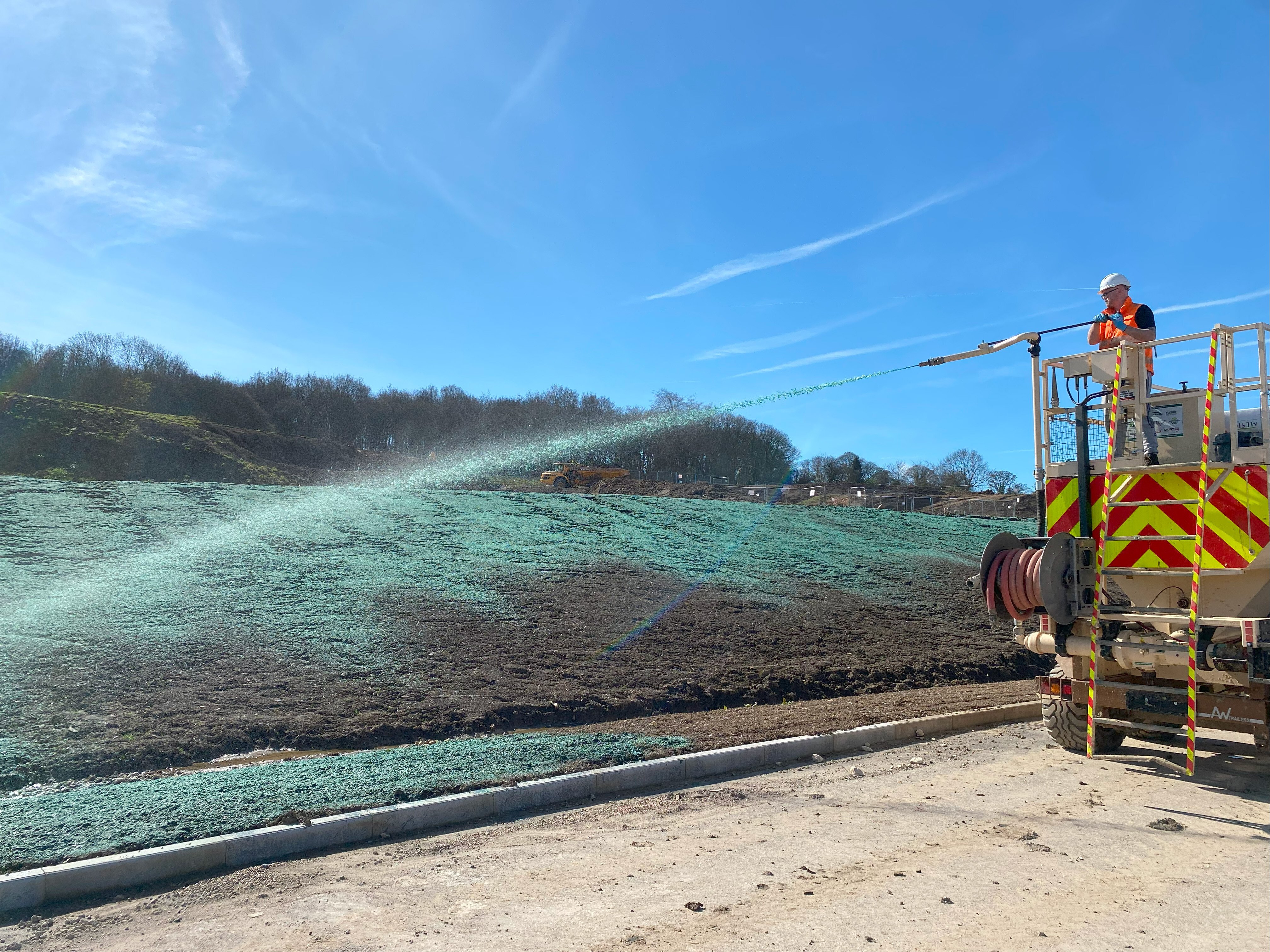
If you live in the Dallas-Fort Worth area you almost certainly have clay soil. North Texas sits on some of the heaviest and most expansive clay deposits in the country — the same black and dark grey soils that crack in summer heat swell with moisture in spring and present a genuine challenge to anyone trying to establish a lawn from scratch. Understanding how clay soil behaves and how to work with it rather than against it is one of the most important things a DFW homeowner can know before starting a hydroseeding project.
This guide covers what clay soil actually does to grass establishment why it creates the problems most North Texas homeowners have experienced and exactly what to do before during and after a hydroseeding application to get the best possible results on heavy clay.
What clay soil is and why it behaves the way it does
Clay soil is defined by the size of the particles that make it up. Clay particles are the smallest of the three main soil particle types — smaller than silt and dramatically smaller than sand — and that particle size drives most of the challenging behaviors that make clay soil frustrating to work with.
Small particle size means that clay soil has very little pore space between particles when compacted. Water and air move slowly through compacted clay which is why clay soils drain poorly stay wet for extended periods after rain and become anaerobic — oxygen depleted — when waterlogged. Those waterlogged anaerobic conditions are hostile to root development and seed germination in ways that sandy or loamy soils are not.
Compaction is the other defining characteristic of clay soil behavior. Clay particles bind tightly together under pressure and the heavy equipment traffic and foot traffic typical of construction activity — which affects most new build lots in the DFW area — produces compaction that is severe enough to prevent root penetration entirely in extreme cases. A shovel pushed into severely compacted North Texas clay meets resistance at a few inches of depth that no grass root can overcome without mechanical intervention.
The shrink-swell behavior of North Texas clay creates another challenge specific to this region. Black clay soils — called Vertisols or Houston Black soils in soil science terminology — expand significantly when wet and contract when dry creating the characteristic cracking that DFW homeowners see in their yards every summer. That cracking physically disrupts shallow root systems and creates channels that concentrate water movement during rain events rather than allowing even absorption across the surface.
Why clay soil makes lawn establishment harder
Each of clay soil's challenging characteristics creates specific problems for lawn establishment that are worth understanding individually.
Poor drainage creates waterlogging during rain events and irrigation. Seed that sits in waterlogged soil during the germination window rots rather than germinates. Young seedlings with shallow root systems drown in anaerobic conditions before they have developed the depth to access the drier soil below the waterlogged layer. The establishment irrigation schedule that produces correct moisture levels on well-drained soil can create damaging waterlogging on heavy clay if not adjusted for the slower drainage rate.
Compaction prevents root penetration. A seedling that germinates successfully on the surface of compacted clay develops roots that hit an impenetrable layer a few inches below the surface and are forced to stay shallow. Shallow-rooted grass on North Texas clay is perpetually stressed — it dries out faster than deeply rooted grass during dry periods and is overwhelmed by heat stress in ways that would not affect a lawn with adequate root depth.
The shrink-swell cycle physically disrupts establishment. Cracking during dry periods opens gaps at the surface that can displace seed before germination and tear young root systems during the vulnerable early establishment phase. The expansion during wet periods creates heaving forces at the soil surface that affect young seedlings differently than mature established grass.
Surface crusting is a clay-specific phenomenon where the surface layer dries to a hard impermeable crust between watering sessions. Seed below a crusted clay surface cannot push through to emerge and seed on top of a crusted surface loses the soil contact needed for germination. The hydroseed mulch layer addresses surface crusting by maintaining moisture between sessions — but if the irrigation interval is too long and the surface crusts between sessions the mulch protection is partially overcome by the clay behavior.
How hydroseeding addresses clay soil challenges
Hydroseeding provides meaningful advantages over broadcast seeding on clay soil specifically because the protective slurry layer addresses several of the clay-specific challenges directly.
The moisture-retaining mulch layer prevents the surface drying and crusting that disrupts broadcast seeding on clay. Between watering sessions the mulch holds moisture at the seed surface and prevents the clay from forming the hard impermeable crust that blocks emergence. Broadcast seed on bare clay surface is fully exposed to the drying conditions between sessions — the slurry layer eliminates that exposure.
Even seed distribution from the hydroseeding application ensures that seed is in contact with the soil surface across the full area rather than concentrated in low spots by rain or wind. On clay soil where surface cracking and uneven terrain affect where broadcast seed ends up after application the controlled delivery of hydroseeding produces more consistent germination patterns.
The starter fertilizer in the slurry provides immediate nutrition at the seed surface — important on clay soils where nutrient availability is often limited by the pH and structural conditions of the native soil. Germinating seeds on clay soil benefit from having nutrition immediately available rather than depending on nutrients moving through slowly draining clay to reach the root zone.
That said hydroseeding does not solve all clay soil problems on its own. The underlying soil structure issues — compaction drainage and surface crusting — need to be addressed through preparation before the application to give the slurry's advantages the conditions they need to produce their full benefit.
Site preparation for clay soil hydroseeding
Preparation is more important on clay soil than on any other soil type and skipping or shortcutting the preparation on a North Texas clay lot is the most reliable path to a disappointing hydroseeding result regardless of how well the application itself is executed.
Mechanical loosening of compacted clay is the most impactful preparation step. Core aeration on moderately compacted yards opens pore space improves drainage and creates channels for root penetration. On severely compacted new construction lots where surface compaction is extreme ripping tilling or skid steer scarification to a depth of four to six inches breaks up the compacted layer and creates a workable seed bed that aeration alone cannot achieve. The loosened soil produced by this mechanical work gives seeds the penetration pathway they need to develop root depth rather than staying at the surface.
Topsoil and organic matter addition improves clay soil structure for establishment and for long-term lawn performance. Adding a two to three inch layer of quality topsoil blended into the loosened clay creates a better surface medium for germination and early root development than native clay subsoil alone. Organic compost mixed into the surface layer improves water retention in the right way — holding available moisture rather than the waterlogged saturation that compacted clay creates — and provides biological activity that improves soil structure over time.
Grade correction for drainage is a preparation step that addresses one of the most consequential clay soil challenges — the tendency of clay to hold water at the surface in low spots rather than draining it away. Correcting grade to eliminate low spots and ensure drainage flows away from structures and toward appropriate outlets before hydroseeding prevents the waterlogging problems during irrigation that are particularly damaging to germination on clay.
Soil pH testing and correction is worth considering on North Texas clay soil that is known to be alkaline. The heavy clay soils of the DFW area can run pH levels above 7.5 — a range that limits the availability of nutrients like iron and manganese that grass needs for healthy growth regardless of fertilizer application. If your soil is known to be significantly alkaline discussing amendment options with your contractor before the application can improve the nutrient availability that new seedlings have access to during establishment.
Irrigation management on clay soil
Watering a hydroseeded lawn on clay soil requires adjustment from the standard guidelines because clay's drainage characteristics change how water moves through the soil profile and how the surface behaves between sessions.
The most important adjustment is reducing individual session duration to prevent surface saturation on clay. The slow drainage rate of heavy clay means that water applied faster than the soil can absorb it either pools at the surface or runs off — neither of which benefits germination. Shorter more frequent sessions that apply water at a rate the clay can absorb between pooling events are more effective on heavy clay than the same total water volume delivered in fewer longer sessions.
Cycle and soak programming on automatic irrigation systems is particularly valuable on clay soil. Running a zone for eight to ten minutes allowing twenty to thirty minutes for initial absorption then running again achieves deeper penetration with less surface pooling than a single continuous session of the same total duration. The absorption break allows the initial water to begin moving into the clay profile before the next application adds to the surface load.
Watch for pooling in low spots as a signal that your current session duration is exceeding the clay's absorption capacity at that location. Reduce session duration in zones covering low-lying clay sections and redistribute the water need to additional sessions rather than longer ones.
The transition from germination watering to establishment watering on clay soil should be gradual — perhaps more gradual than on well-drained soil — because the clay's slow drainage means that transitioning to deep infrequent watering before the root system has the depth to access the moisture that penetrated in the previous session can create a cycle of surface moisture stress. Progress the transition as root development and germination confirm that the lawn is ready rather than on a strict calendar schedule.
Grass selection for clay soil in North Texas
Grass variety selection for clay soil in the DFW area should account for the specific characteristics that affect performance in heavy clay conditions.
Bermudagrass is well-adapted to the clay soils of North Texas. Its aggressive lateral spread and deep root system development are characteristics that evolved in conditions similar to the heavy soils of its native range. Established Bermuda in North Texas clay develops root systems that penetrate significantly into the soil profile — deeper than most homeowners expect — and that root depth gives it the drought tolerance and heat resilience that makes it the dominant lawn grass across the region.
Buffalograss is the native grass most completely adapted to North Texas clay soils. It evolved on the same black clay prairies that define the soil type of this region and has the deepest root system of any common lawn grass option in this market. Its natural adaptation to clay soils means it requires less soil amendment and less structural preparation than imported grass varieties to perform well — though proper establishment preparation still improves results compared to no preparation.
Tall Fescue performs reasonably well on clay soils in shaded conditions where it is the appropriate grass type but it is more susceptible to the waterlogging that clay drainage characteristics create than warm-season alternatives. Ensuring that drainage is adequate before establishing Fescue on clay is more important for Fescue than for Bermuda because Fescue does not tolerate standing water conditions as well.
Long-term clay soil management for established lawns
Getting a lawn established on clay soil is the beginning of an ongoing relationship with the soil conditions rather than a solved problem. Clay soil management through the life of the lawn affects how well the established grass performs and how much ongoing maintenance intervention is required.
Annual aeration is one of the highest-value maintenance practices for established lawns on North Texas clay. The compaction tendency of clay reasserts itself over time under mowing traffic and seasonal shrink-swell cycles. Annual core aeration keeps pore space open improves water penetration and provides the channels that allow organic matter from topdressing to work into the soil profile rather than sitting on top of it.
Annual topdressing with compost applied after aeration gradually improves the organic matter content of clay soil over multiple seasons. A thin quarter to half inch layer of quality compost applied after aeration and worked into the aeration holes improves water retention structure and biological activity in the soil surface layer — measurable improvements that compound over years of consistent application.
Deep infrequent watering for established lawns on clay trains root systems to develop the depth that makes lawns resilient on clay soils. The same deep watering principle that applies to establishment watering applies throughout the life of the lawn — keeping the root system deep ensures it accesses moisture from the lower soil profile where clay's water retention is an asset rather than the shallow zone where surface drying and crusting are liabilities.
The bottom line on hydroseeding clay soil in Texas
Heavy clay soil presents real challenges for lawn establishment in North Texas — compaction drainage surface crusting and shrink-swell behavior that affects everything from germination to long-term root development. Hydroseeding addresses more of these challenges than broadcast seeding through its protective slurry layer but the underlying soil preparation work is what determines whether the application produces the results it is capable of.
Mechanical loosening of compaction topsoil and organic matter addition grade correction for drainage and appropriate irrigation management for clay-specific behavior are the preparation and management steps that separate successful clay soil establishment from the repeated disappointment that many North Texas homeowners experience when these factors are not addressed. Get the preparation right match the grass to the conditions and manage irrigation for clay behavior and the result is a lawn that handles everything the DFW climate produces.

Dealing with heavy clay soil and struggling to get grass to establish?
Fox Hydroseeding LLC works with clay soil conditions across the DFW area every day and personally assesses every yard before recommending a preparation approach and seed mix. We know North Texas clay and how to get lawns established right on it.
Get Your Free Estimate → foxhydroseeding.com/contact
Bring Your Property to Life With Expert Hydroseeding
Find Us On


Email address

Phone Number

