


Hydroseeding for a sloped yard — why slopes are so hard to seed and how hydroseeding solves it
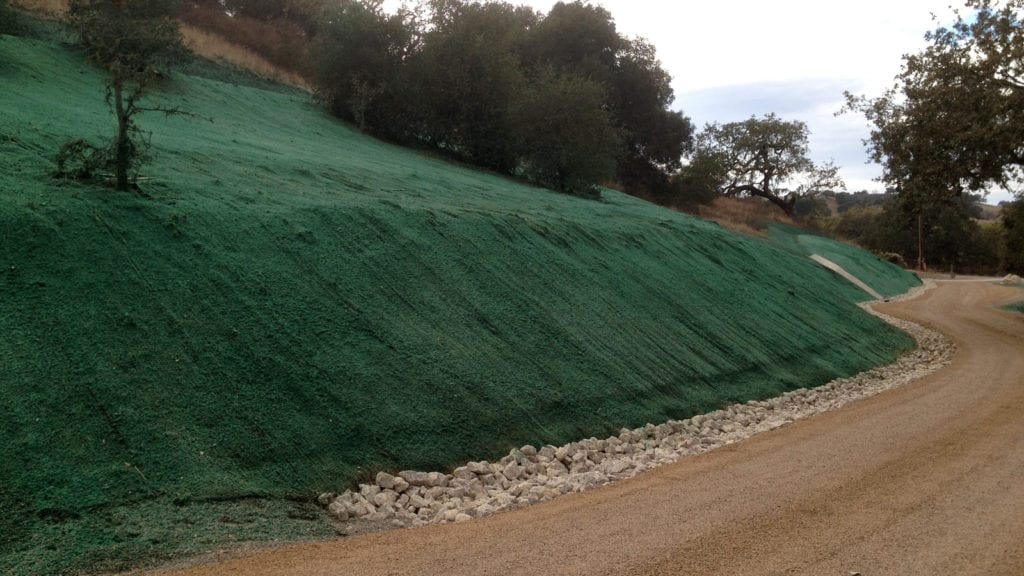
If your yard has a slope you have probably already discovered that getting grass to grow on it is harder than it looks. Seed washes to the bottom of the hill after every rain. Bare patches persist despite repeated reseeding attempts. The slope dries out faster than the flat areas and seems to need constant attention just to maintain a thin struggling cover that never fills in the way the rest of the yard does. Slopes are genuinely difficult to establish grass on with conventional seeding methods — and the difficulty increases with the steepness of the grade.
Hydroseeding was developed in part specifically to address the challenges of establishing vegetation on slopes where conventional seeding methods consistently fail. This guide explains why slopes are so hard to seed what hydroseeding does differently and what North Texas homeowners with sloped yards need to know before starting a slope establishment project.
Why slopes are so difficult to seed with conventional methods
Understanding why slopes create the specific problems they do helps explain why hydroseeding addresses them so much more effectively than alternatives.
Broadcast seeding on slopes faces the fundamental problem that loose seed on a sloped surface does not stay where it is applied. Rainfall and irrigation water running down the slope carries lightweight seed with it — concentrating seed at the base of the slope and leaving the upper sections bare. Wind displacement is amplified on open slopes where there is less surrounding vegetation to buffer movement. Birds and other wildlife find exposed seed on slopes easily accessible. The result of broadcast seeding on a slope in most Texas conditions is heavy germination at the bottom of the hill and bare or very thin coverage on the upper sections where seed did not stay.
Sod on slopes faces the problem of physical stability during establishment. Sod rolls laid on steep slopes tend to slide shift and separate at the seams before roots have developed enough to anchor them. The labor cost of staking or pinning sod on steep slopes is significant and even well-installed sloped sod is vulnerable to heavy rain events that saturate the root zone and create conditions where the mat slides before establishment is complete.
Irrigation management on slopes is inherently more challenging than on flat surfaces. Water runs down slopes rather than soaking in uniformly — the upper sections of a slope dry out faster than the lower sections because the water applied to the upper sections runs to the lower sections rather than staying where it lands. This creates a moisture gradient across the slope that produces uneven germination and uneven establishment regardless of how much total water is applied.
Erosion during the establishment window is the combined result of all of these factors. A bare or sparsely vegetated slope loses topsoil with every rain event — the same erosion that motivated the seeding attempt in the first place continues and intensifies while the establishment is failing.
What hydroseeding does differently on slopes
Hydroseeding addresses the specific challenges of slope establishment in ways that neither broadcast seeding nor sod can match.
The slurry bonds to the slope surface. The tackifier in the hydroseeding mix causes the slurry to adhere to the soil surface on contact — including on sloped surfaces where gravity is working against seed retention. Rather than seed sitting loosely on a slope surface waiting to be displaced the slurry forms a cohesive layer that is bonded to the slope from the moment it is applied.
The mulch layer holds everything in place during the critical germination window. Fiber mulch in the slurry forms a physical matrix over the slope surface that resists the water movement that washes bare seed downhill. Rain and irrigation water moves through the mulch layer rather than carrying it downhill — protecting the seed beneath while allowing the moisture needed for germination to reach the soil.
The mulch layer also moderates the moisture gradient that makes slope irrigation so difficult. By retaining moisture at the surface across the full slope rather than allowing it to run immediately to the lower sections the mulch improves the moisture uniformity that produces more consistent germination from the top of the slope to the bottom.
The erosion protection of the mulch layer begins immediately on application day regardless of where germination stands. The physical coverage and water impact absorption of the fiber mulch reduces soil loss from the slope from the first rain event after application — protecting the topsoil that the future lawn depends on even before a single seed has germinated.
Standard hydromulch versus BFM on slopes
The mulch product selection for a sloped yard hydroseeding application depends on the steepness of the grade and the erosion risk during the establishment window.
Standard wood fiber hydromulch is appropriate for moderate slopes — grades where the slope is meaningful but not steep enough to generate the runoff velocity that would displace the mulch before it bonds to the surface. For most standard residential slopes in the DFW area — the back yard that drops off toward a drainage easement the side yard that grades away from the house foundation the gentle slope from the front yard down toward the street — standard hydromulch performs well when applied correctly.
Bonded fiber matrix is the appropriate product for steeper grades where the erosion risk is significant enough that standard mulch may wash off before the grass establishes. BFM contains bonding agents that cause the fibers to interlock after application forming a continuous mat rather than a loose fiber layer. That mat stays in place through significant rainfall events on steep grades where standard mulch would have washed away long before germination was complete.
The practical slope threshold where BFM becomes the appropriate product rather than standard mulch is approximately a 3 to 1 ratio — three feet of horizontal run for every one foot of vertical rise or steeper. For grades steeper than that a qualified contractor will typically recommend BFM over standard mulch to ensure the mulch protection persists through the full establishment window.
Your contractor should assess the specific grade of your slope during the estimate and make a clear product recommendation rather than defaulting to one product without evaluating the site. A contractor who recommends standard mulch for a clearly steep slope without explanation is either not assessing the grade carefully or is quoting the cheaper product without regard for whether it is appropriate for the conditions.
Irrigation management for sloped yard hydroseeding
The irrigation management challenge on slopes requires specific adjustments from standard flat-area hydroseeding protocols — both during the establishment window and for the long-term maintenance of the established lawn.
During the germination window on a slope shorter more frequent irrigation sessions outperform longer less frequent ones. Long irrigation sessions on slopes generate more runoff than short ones — the soil on the slope reaches its absorption capacity and begins shedding water downhill before the session ends. Shorter sessions that apply water at or below the absorption rate penetrate more effectively and with less surface displacement than longer sessions that exceed it.
Cycle and soak programming is particularly valuable on slopes. Running irrigation for five to eight minutes allowing twenty to thirty minutes for absorption and then running again delivers more effective penetration with less runoff than a single longer session of the same total duration. The absorption break allows water to begin moving into the soil profile before the next increment adds to the surface load.
Monitor the lower sections of the slope for excess moisture accumulation and the upper sections for drying between sessions. The moisture gradient on slopes means that the bottom of the hill is always wetter than the top — adjusting session duration and frequency to keep the full slope within an acceptable moisture range rather than managing to the average across the area produces more even germination.
For established slopes the same cycle and soak principle applies to long-term irrigation management. Deep penetration on slopes requires patient application that allows the clay-heavy soils typical of North Texas to absorb water gradually rather than forcing excessive runoff from long sessions.
Seed selection for sloped yards
Grass selection for sloped yards in North Texas should account for the specific demands of slope conditions alongside the standard sun exposure and soil type considerations.
Root system characteristics matter more on slopes than on flat areas because deep fibrous roots are what provide the permanent erosion protection that a slope needs after grass establishment. Bermudagrass with its aggressive deep-growing root system and dense lateral spread is well-suited to full-sun slopes in the DFW area — it establishes relatively quickly compared to other options and produces the dense root mat that holds slope soil effectively once established.
For shaded slopes where Bermuda will not perform Tall Fescue's deep fibrous root system provides meaningful slope stabilization in the shade-tolerant grass category appropriate for North Texas. Fescue on shaded slopes requires the same fall timing for establishment that applies to all Fescue seeding in this market.
For larger slopes on rural properties or commercial sites where the goal is permanent erosion control rather than traditional lawn turf native grass species with particularly deep root systems — species like Sideoats Grama Little Bluestem and Buffalograss — provide the most durable long-term stabilization because their root depth far exceeds what conventional turfgrasses achieve.
What to expect from slope establishment
Slope establishment through hydroseeding follows the same general timeline as flat-area applications — first sprouts in five to ten days solid coverage developing through weeks two through four first mow at weeks four through five. However slope germination is often slightly less uniform than flat-area germination because of the moisture gradient and the physical dynamics of the sloped surface.
It is normal for the lower sections of a slope to show earlier and more robust early germination than the upper sections — the moisture accumulation at the base of the slope creates better early germination conditions. The upper sections typically catch up as root systems develop and the moisture dynamics of an establishing lawn begin to differ from bare soil moisture dynamics.
Assess establishment progress at both the top and bottom of the slope rather than evaluating the whole slope from the bottom where early germination is strongest. If the upper sections are significantly behind by day fourteen — not just slightly behind but showing little to no germination compared to active germination in the lower sections — irrigation management adjustment may be needed to improve moisture delivery to the drier upper sections.
Long-term slope lawn management
An established hydroseeded lawn on a slope requires some ongoing management differences from flat lawn areas to maintain the coverage and root depth that provides the slope's long-term stabilization.
Mowing on slopes requires appropriate equipment and technique. Steep slopes that cannot be safely mowed with a standard walk-behind mower may require a reel mower specifically designed for slope work or a string trimmer for maintenance — safety should always determine the mowing approach on steep grades rather than attempting to use standard equipment in conditions it was not designed for.
Annual overseeding of thin areas that develop on slopes — particularly in the upper sections that experience the greatest moisture stress — maintains coverage density over time. Slopes tend to thin first at the top where conditions are driest and most exposed and annual fall overseeding of those sections maintains the density that slope erosion protection requires.
Aeration on established slopes helps maintain the soil structure and root penetration conditions that prevent the compaction-related thinning that slopes are susceptible to under mowing and weather cycles.
The bottom line on hydroseeding for sloped yards
Slopes are genuinely difficult to establish grass on with conventional seeding methods and the difficulty is rooted in physical realities — seed displacement moisture gradients and erosion during the establishment window — that broadcast seeding and sod installation cannot overcome the way hydroseeding does.
The combination of slurry adhesion mulch layer retention moisture moderation and immediate erosion protection that hydroseeding provides addresses each of the slope-specific establishment challenges directly. With the right mulch product for the grade appropriate slope-adjusted irrigation management and the right seed for the sun exposure and conditions of the specific slope a hydroseeded hill produces the permanent vegetation cover that is the most durable slope stabilization solution available.

Dealing with a slope in your yard that you cannot get grass to grow on?
Fox Hydroseeding LLC handles slope hydroseeding applications across the DFW area and assesses every grade personally before recommending a product and approach. We know what it takes to get grass established on a hill and we do it right the first time.
Get Your Free Estimate → foxhydroseeding.com/contact
Bring Your Property to Life With Expert Hydroseeding
Find Us On


Email address

Phone Number

