


Hydroseeding FAQs — honest answers to the questions homeowners ask most
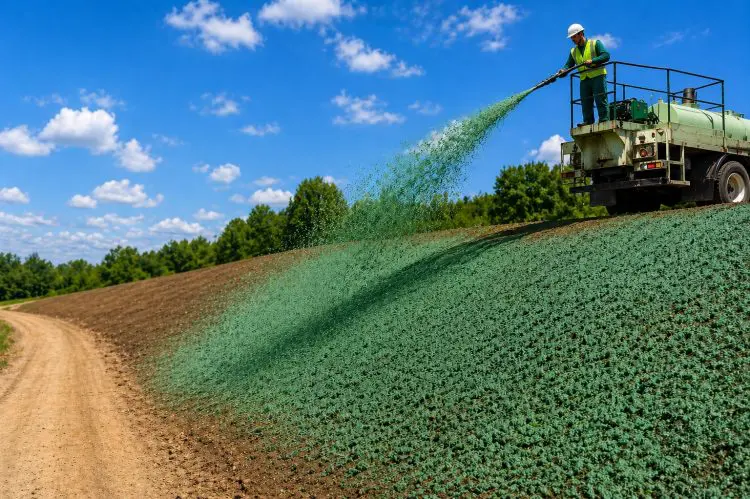
If you are researching hydroseeding for the first time, you probably have a lot of questions. What does it cost? How long does it take? Do you have to stay off the lawn? What if it rains? This guide compiles the most common questions homeowners ask about hydroseeding and answers them honestly and directly so you can move forward with confidence.
What is hydroseeding?
Hydroseeding is a lawn establishment method where grass seed, fiber mulch, fertilizer, tackifier, and water are mixed into a slurry and sprayed onto prepared soil using a specialized machine called a hydroseeder. The mulch layer bonds to the soil surface, retains moisture around the seed, and protects against heat, wind, and erosion during the germination window. It is used for residential lawns, commercial properties, new construction lots, slopes, and large acreage applications across Texas and throughout the country.
Is hydroseeding the same as hydromulching?
Yes. Hydromulching and hydroseeding refer to the same process. The terms are used interchangeably across the Texas market and most of the country. Some contractors prefer one term over the other, but the equipment, the process, and the result are identical. If you are comparing quotes and one contractor calls it hydroseeding while another calls it hydromulching, do not let the terminology confuse the comparison — focus on the seed quality, mulch product, and contractor experience instead.
How much does hydroseeding cost?
Hydroseeding is priced by the square foot, and the cost varies based on square footage, seed type, mulch product, site conditions, and whether site preparation is included. As a general rule, hydroseeding costs significantly less than sod installation for the same area — often a fraction of the sod cost on larger residential lots. The most accurate way to understand what your specific project will cost is to get a written on-site estimate from a qualified contractor who has walked your property.
How long does hydroseeding take to grow?
Most homeowners see the first sprouts within five to seven days under proper watering conditions. Full, even coverage typically develops over three to four weeks. A fully established lawn with a deep root system ready for regular mowing and normal use takes four to six weeks from the application date. Timeline varies based on grass type, soil conditions, time of year, and how consistently the lawn is watered during the germination window.
How often do I need to water after hydroseeding?
During the first fourteen days, water two to three times per day with light, even sessions that keep the surface consistently moist. Around day fourteen, begin transitioning to deeper, less frequent watering sessions that encourage roots to grow downward. By week four, transition to a mature lawn watering schedule of one to two deep sessions per week depending on weather and soil conditions. Consistent watering during the first two weeks is the single most important factor in whether a hydroseeded lawn establishes successfully.
Can I walk on my lawn after hydroseeding?
Avoid all foot traffic on the hydroseeded area for the first three to four weeks. The seed mat is fragile during the germination and early establishment phases, and foot traffic compresses the soil, disrupts germination, and tears up seedlings before they are established. Keep pets off the lawn during this window as well. After the first mow — typically around weeks four to five — the lawn is established enough to handle light normal use.
What if it rains right after my hydroseeding application?
Light rain in the first 24 hours is generally fine and can actually support germination by providing natural moisture. Heavy rain or significant runoff in the first 48 hours — particularly on slopes — can displace the slurry before the mulch layer has bonded to the soil. If you notice visible channels where the slurry has washed away or accumulation of mulch material in low spots, contact your contractor to assess whether a touchup application is needed.
When can I mow after hydroseeding?
Wait until the grass reaches three to four inches before mowing for the first time. For most DFW properties seeded during spring or summer, this happens somewhere between weeks four and five after application. When you do mow, keep the blade high — no lower than two and a half to three inches — and use a sharp blade. Do not mow when the ground is wet or soft, and never remove more than one third of the blade height in a single session.
What grass types can be hydroseeded?
Most grass varieties that are available in seed form can be hydroseeded. Common options in the DFW and North Texas market include Bermudagrass for full-sun warm-season lawns, Tall Fescue for shaded areas and cool-season coverage, Buffalograss for low-maintenance drought-tolerant applications, Ryegrass for seasonal overseeding on dormant Bermuda lawns, and native grass and wildflower mixes for large rural properties and naturalized areas. Your contractor should recommend the right mix for your specific sun exposure, soil conditions, and intended use.
Does hydroseeding work on slopes?
Yes — and in many cases it works better than alternatives on sloped terrain. The hydroseed slurry can be sprayed onto slopes where laying sod would be difficult or impractical, and the mulch layer provides immediate erosion protection during the germination window. Steeper slopes may require bonded fiber matrix rather than standard hydromulch for adequate erosion control. Your contractor will assess the grade and recommend the appropriate product during the estimate.
What is bonded fiber matrix and do I need it?
Bonded fiber matrix — commonly called BFM — is a premium hydroseeding mulch product where fibers are bonded together to form a continuous mat over the soil surface after application. Unlike standard wood or paper fiber mulch, BFM stays in place through heavy rainfall events, making it the appropriate product for steep slopes, erosion-prone areas, permitted construction sites, and drainage-adjacent applications where standard mulch would wash away. Most standard residential lawn applications on flat to moderately sloped terrain do not require BFM — standard hydromulch performs well in those conditions.
Do I need to prepare my yard before hydroseeding?
Yes. Site preparation is one of the most important factors in a successful hydroseeding outcome. At minimum, the surface should be graded smooth, cleared of debris, and loosened enough for seed-to-soil contact. On new construction lots, significantly compacted yards, or properties with poor soil quality, more extensive preparation — grading, topsoil addition, aeration — may be needed before the application. A contractor who walks your property during the estimate should give you an honest assessment of what prep is required for your specific yard.
How is hydroseeding different from broadcast seeding?
Broadcast seeding scatters seed across the soil surface without any protective covering. Hydroseeding applies seed within a protective mulch layer that retains moisture, protects against heat and wind, and keeps seed in place during the germination window. The result is significantly more reliable germination — especially in Texas conditions where bare seed on the surface is exposed to heat, wind, and uneven rainfall that can dry it out or wash it away before it establishes. Hydroseeding consistently outperforms broadcast seeding in Texas across most property types and conditions.
Is hydroseeding better than sod?
For most applications, hydroseeding delivers better long-term value than sod at significantly lower cost. Sod offers the advantage of instant coverage — a finished-looking lawn within days of installation — which is the right choice when timeline is the primary concern. Hydroseeding produces a lawn that is naturally rooted in your specific soil conditions, develops deeper root systems over time, and costs a fraction of what sod installation runs on most residential lot sizes. For homeowners who can allow three to four weeks for establishment and whose primary concern is long-term lawn quality at the best value, hydroseeding is the better option.
What happens if my hydroseed does not grow?
The most common causes of poor germination after hydroseeding are inconsistent watering, soil temperature mismatch for the seed type used, poor seed-to-soil contact from inadequate site prep, compacted soil preventing root development, shade blocking germination of sun-loving grass varieties, or washout from heavy rain displacing the slurry before it bonded. If your lawn is past the two week mark with little to no germination across the majority of the seeded area, contact your contractor to assess the situation. Most germination failures can be traced to one of these causes — identifying the right one determines the appropriate corrective action.
What is the best time of year to hydroseed in Texas?
For warm-season grasses like Bermudagrass, late March through May is the best window in the DFW area — soil temperatures are rising into the germination range and the full growing season is ahead. Summer applications are possible but require more aggressive irrigation management. For cool-season grasses like Tall Fescue, fall — October through mid-November — is the optimal window in North Texas. Winter is generally not recommended for new lawn establishment in this region.
Do I need to fertilize after hydroseeding?
Most professional hydroseeding applications include a starter fertilizer in the slurry mix, which provides nutrition during the germination and early establishment phases — typically the first four to six weeks. After that, a standard lawn fertilizer program appropriate for your grass type and the season maintains healthy ongoing growth. Ask your contractor what was included in the mix and what fertilizer schedule they recommend for your specific seed type.
How long does a hydroseeding application take?
Most standard residential yards can be hydroseeded in a few hours. Larger lots, properties with complex layouts, or commercial and large acreage projects may take longer or require multiple mobilizations. The yard is ready to water immediately after the contractor leaves — there is no curing time required before the first watering session.
Can hydroseeding be done in summer in Texas?
Yes — summer hydroseeding in Texas is done regularly and produces fast germination results because warm-season grasses like Bermuda are in their peak growing window. The challenge is that summer heat and low humidity in the DFW area require a committed watering schedule — two to three times per day during the first two weeks — to prevent the seed bed from drying out. Homeowners who can commit to that watering schedule get excellent summer hydroseeding results. Those who travel frequently or have limited irrigation access are better served by timing the project for spring or fall.
How do I choose a hydroseeding contractor?
Look for a contractor who walks your property before quoting rather than giving a price per square foot over the phone, can clearly explain the seed mix and mulch product being used and why they are right for your yard, provides a written estimate that breaks down exactly what is included, walks you through aftercare expectations before leaving the job site, and has a track record of completed work in your area. Owner-operated companies where the person doing the estimate is also doing the work tend to produce more consistent, accountable results than larger operations where the owner is removed from the day-to-day execution.
The bottom line
Hydroseeding is one of the best investments a homeowner can make in a new lawn — reliable, cost-effective, and well-suited to the conditions and grass types that perform best in Texas. Most of the questions homeowners have before starting a project come down to timing, watering, and what to expect at each stage — all of which are manageable with the right contractor and the right preparation going in.

Still have questions about your specific property or project?
Fox Hydroseeding LLC is owner-operated and personally handles every estimate and every question that comes up before, during, and after a hydroseeding job. We are here to make the process straightforward from start to finish.
Get Your Free Estimate → foxhydroseeding.com/contact
Bring Your Property to Life With Expert Hydroseeding
Find Us On


Email address

Phone Number

