

Do you need topsoil before hydroseeding — and how much is actually enough
Topsoil is one of the preparation line items that homeowners evaluating hydroseeding estimates frequently question. It adds real cost to the project and it is not visible in the finished result — once the grass is established nobody can see what is underneath it. The question of whether the topsoil addition is genuinely necessary or whether it is an upsell that a prepared homeowner can skip is a legitimate one and it deserves a direct honest answer rather than a reflexive recommendation to always add more soil.
The honest answer is that topsoil addition is sometimes essential sometimes beneficial and sometimes genuinely unnecessary — and which of those three situations applies to your specific property is determined by the actual condition of the existing soil rather than by a blanket rule.
This guide covers how to determine which situation your yard is in what topsoil actually provides that makes it worth the investment when it is needed and how much is appropriate when the conditions warrant it.
What topsoil actually does for a hydroseeded lawn
Before assessing whether your yard needs topsoil it helps to understand what topsoil provides that makes it valuable — because understanding the function clarifies when the function is needed and when it is already present without adding anything.
Topsoil provides organic matter. Quality screened topsoil contains decomposed organic material — the carbon-based compounds that improve soil structure water retention and biological activity. This organic matter is what makes topsoil so different in texture and behavior from the compacted clay subsoil that underlies most of North Texas. The organic matter in topsoil creates the aggregate structure that gives quality soil its crumbly texture allows roots to penetrate more easily and holds moisture in plant-available form between irrigation sessions.
Topsoil provides biological activity. The organic matter in quality topsoil supports a community of microorganisms — bacteria fungi and other organisms — that process nutrients cycle minerals and contribute to the soil structure that healthy grass roots develop in. The biologically active soil that topsoil provides supports grass root development in ways that the biologically depleted compacted subsoil of a new construction lot does not.
Topsoil provides a germination medium. The combination of organic matter biological activity and better physical structure that quality topsoil provides creates a germination environment that supports better seed-to-soil contact moisture retention and initial root development than dense compacted clay subsoil without organic matter. Seeds germinating in quality topsoil have better access to the conditions that early root development requires.
These three functions — organic matter biological activity and germination medium — are what topsoil provides. The question of whether your yard needs topsoil added is really the question of whether the existing surface soil already provides these functions adequately or whether the conditions have depleted or removed them.
The situations where topsoil addition is essential
New construction lots in the DFW area represent the clearest case where topsoil addition is genuinely essential rather than optional. The construction process that creates new home lots almost universally strips the organic-rich topsoil layer — either removing it entirely during excavation or burying it under fill material during grading. What remains at the surface is the compacted clay subsoil that has minimal organic matter minimal biological activity and poor structure for root development.
Hydroseeding directly onto stripped construction subsoil without topsoil addition produces the germination that the seed and slurry quality support — but the root development after germination encounters the hostile growing conditions of organic-depleted compacted clay and produces the shallow-rooted first-year lawn that struggles through its first Texas summer because the growing medium never provided what root depth development requires.
On new construction lots topsoil addition is the preparation investment that changes the growing medium from hostile to functional — and the improvement in first-year establishment quality between applications on stripped subsoil and applications on quality topsoil over loosened subsoil is visible and significant through the first growing season.
Renovated yards where years of soil degradation have depleted the topsoil layer are the second situation where topsoil addition is genuinely needed. Repeated cultivation without organic matter addition compaction from years of equipment and traffic and the progressive loss of organic matter through decomposition without replacement can deplete the topsoil layer of a residential lot that once had adequate quality to the point where the surface soil has more in common with construction subsoil than with quality topsoil. If a soil probe in the existing surface reveals dense clay with no visible organic matter and the lawn has been declining progressively despite management inputs that should be producing improvement the soil quality may have depleted to the point where topsoil addition is the intervention the renovation requires.
The situations where topsoil addition is beneficial but not essential
Properties with existing soil that has some organic matter content and reasonable structure — that is not the stripped construction subsoil worst case but also not the high-quality loam that topsoil addition would be replacing — fall into the category where topsoil addition is beneficial but not strictly essential.
Adding two to three inches of quality topsoil to a property in this category produces better establishment quality than proceeding without it — faster germination more consistent coverage better first-year root development and higher turf density through the first growing season. The improvement is real and the investment is justified by the better result it produces.
But the baseline establishment quality on moderately adequate existing soil without topsoil addition is not the failure-risk scenario that stripped construction subsoil presents. Hydroseeding on moderately adequate existing soil with proper compaction relief produces a lawn that establishes and performs acceptably — not at the ceiling that quality topsoil enables but above the floor of failure that inadequate conditions produce.
The decision in this middle-ground situation is a quality-versus-cost trade-off that the homeowner makes with accurate information about what topsoil addition improves rather than based on uncertainty about whether it is necessary.
The situations where topsoil addition is genuinely unnecessary
Properties with high-quality existing surface soil — adequate organic matter good biological activity reasonable structure and depth — do not benefit meaningfully from topsoil addition because the conditions that topsoil provides are already present.
In the DFW area these properties are less common than the new construction and depleted-soil scenarios above — the combination of naturally heavy clay soil and the development history of most DFW residential properties means that genuinely high-quality native topsoil is the exception rather than the rule. But they exist — particularly on properties with established trees whose leaf litter has been composting into the surface soil for decades on properties where previous owners consistently amended and topdressed and on properties in specific areas of the metroplex where the native soil quality is better than the heavy black clay that characterizes most of the region.
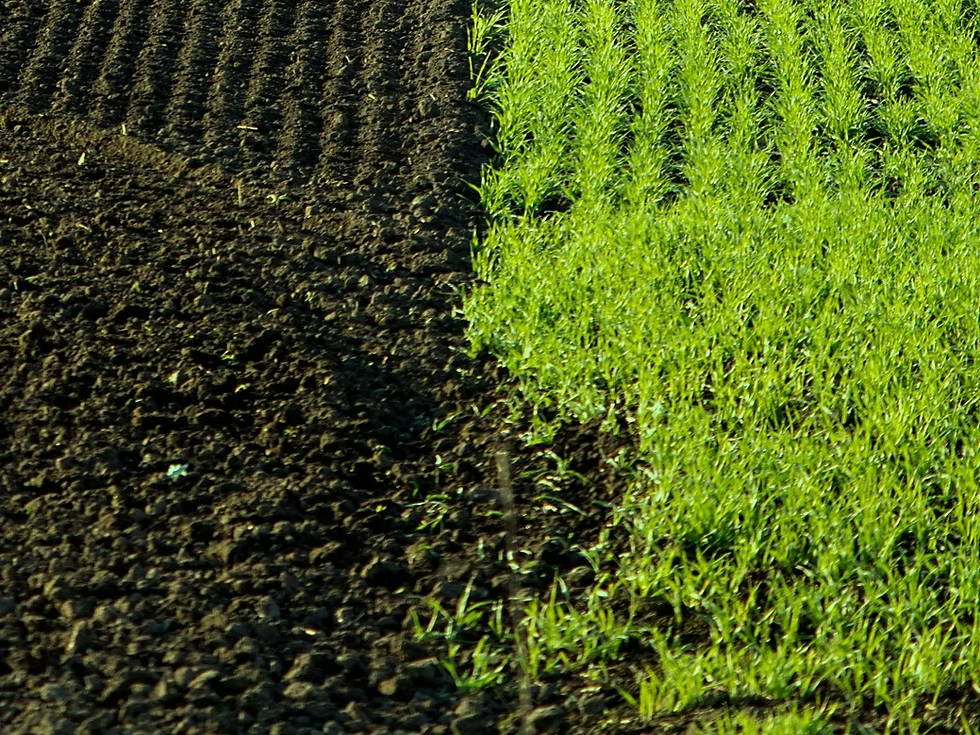
The field test for whether topsoil is genuinely unnecessary is simple. Dig a shovel depth into the surface of the area to be seeded. If the first six inches of soil are loose crumbly dark in color with visible organic material and biological activity — earthworm castings root material fungal threads — the existing soil is functioning as quality topsoil and adding more is not a necessary investment. If the first six inches are dense compacted light-colored clay with no visible organic matter and no biological activity the soil needs improvement.
How to assess your specific soil condition
The field assessment that determines which category your property falls into takes about fifteen minutes and no specialized equipment.
Walk to several locations across the yard and push a screwdriver or soil probe into the surface to a depth of six inches. Note how much resistance the probe meets — easy penetration through the first few inches indicates loosely structured soil hard resistance almost immediately indicates compaction. Note the color and texture of the soil brought up by the probe — dark and crumbly indicates organic matter presence light-colored and dense indicates depleted mineral clay.
Dig a small hole about six inches deep in a representative area and examine the soil profile. The depth and color of any darker topsoil layer visible above the lighter subsoil tells you how much topsoil quality remains. A visible topsoil layer of three inches or more that is darker and more granular than the material below it suggests adequate existing quality. A thin layer of one inch or less transitioning directly to pale dense clay suggests significant depletion. No visible topsoil layer at all — the surface is the same color and density as material six inches down — suggests construction stripping.
Take this assessment into the contractor conversation. A contractor who agrees with your assessment or who independently arrives at the same conclusion during their site walkthrough is demonstrating the soil evaluation capability that informs honest preparation recommendations.
How much topsoil is actually enough
When topsoil addition is warranted the question of how much to add has a practical answer that accounts for both the functional goal and the cost efficiency of the investment.
Two to three inches of quality screened topsoil blended into the top four to six inches of the loosened native soil is the standard recommendation for new construction lots and significantly depleted soils in the DFW area. This depth provides enough organic matter and improved structure to meaningfully affect the germination medium and early root development environment while staying within the cost range that most residential projects can accommodate.
Less than two inches of topsoil on a stripped construction lot provides less improvement than the preparation investment produces — the layer is thin enough that roots moving downward from the topsoil layer encounter the depleted subsoil conditions quickly rather than having an adequate depth of improved growing medium to develop in.
More than three inches of topsoil on a standard residential lot is rarely necessary for the germination and establishment quality goal that topsoil addition serves — the first-year root development that occurs in the top six to eight inches of the soil profile benefits from two to three inches of quality topsoil over loosened native clay without requiring a deeper topsoil layer that adds cost without proportional establishment quality improvement.
The blending step — working the topsoil addition into the top layer of the loosened native soil rather than leaving it as a distinct layer sitting on top — is as important as the depth specification. A distinct topsoil layer sitting on top of compacted clay creates a transition that root systems moving downward hit — the better-structured topsoil over the denser clay can create a perched water table condition where moisture accumulates at the interface rather than penetrating into the profile. Blending creates a gradual transition that roots penetrate through continuously rather than encountering as a distinct barrier.
What quality topsoil actually means
Not all topsoil sold under the name topsoil is equal and the quality variation in the topsoil market is significant enough to matter for the investment it represents.
Quality screened topsoil has visible organic matter — dark color from decomposed organic material — adequate biological activity as evidenced by earthy smell and visible biological presence and a texture that is noticeably different from raw clay — slightly granular and more workable rather than dense and plastic.
Low-quality topsoil — sometimes sold as fill or screened fill — may be primarily mineral material with minimal organic matter content that does not provide the growing medium improvement that the topsoil addition investment is intended to deliver. Purchasing from a reputable local supplier who can confirm the organic matter content and soil composition of their topsoil product rather than from the lowest-priced source protects the investment from the disappointment of applying material that looks like topsoil but performs like the depleted soil it was intended to improve.
Ask your hydroseeding contractor specifically about the topsoil source if they are supplying and delivering it as part of the preparation scope. A contractor who can name the supplier and describe the quality characteristics of the topsoil they use is demonstrating the product knowledge that protects the preparation investment.
The bottom line on topsoil before hydroseeding
Topsoil before hydroseeding is essential on new construction lots and significantly depleted soils beneficial but not essential on moderately adequate existing soils and genuinely unnecessary on properties with high-quality existing surface conditions. The field assessment that determines which situation applies to your specific property takes fifteen minutes and requires no specialized equipment — and it produces the accurate information that makes the topsoil decision a quality-versus-cost trade-off with accurate inputs rather than an uncertain one made without the information needed to evaluate it honestly.
When topsoil is warranted two to three inches of quality screened material blended into the loosened native soil is the specification that produces the meaningful improvement in germination medium and early root development environment that the investment is intended to deliver.

Not sure whether your yard needs topsoil before hydroseeding or want an honest soil assessment before making any decisions?
Fox Hydroseeding LLC personally assesses the soil condition of every property during the estimate walkthrough and gives you an honest evaluation of what the specific conditions of your yard require. We do not recommend topsoil when it is not warranted and we do not skip it when it is.
Get Your Free Estimate → foxhydroseeding.com/contact
Bring Your Property to Life With Expert Hydroseeding
Find Us On


Email address

Phone Number

