

Commercial hydroseeding — what contractors and developers need to know before hiring
Residential lawn jobs and commercial hydroseeding projects are not the same thing. The scale is different, the timelines are tighter, the coordination requirements are more demanding, and the consequences of a poorly executed job are more significant. If you are a general contractor, developer, or property manager in the DFW area looking for a reliable hydroseeding subcontractor, this guide covers what the process looks like at a commercial scale and what to look for before you commit to anyone.
What commercial hydroseeding covers
Commercial hydroseeding in the DFW area applies to a wide range of project types beyond standard residential lawn work. Subdivision common areas and HOA grounds, new commercial developments and mixed-use properties, office park and industrial facility landscaping, highway and roadway embankments, post-construction revegetation on large disturbed sites, retention pond banks and drainage channel stabilization, and municipal and public works projects all fall under commercial hydroseeding work.
What these projects share is scale — larger square footage, tighter deadlines, coordination with other trades, and in many cases specific product and application requirements tied to permits, stormwater management plans, or municipal specifications.
Why commercial projects require a different approach
A hydroseeding contractor who handles residential lawns efficiently is not automatically equipped to handle commercial work at scale. The differences go beyond just having a bigger tank.
Equipment capacity matters. Larger commercial sites require hydroseeding equipment with sufficient tank volume to cover large areas without constant refilling, which slows the job and creates inconsistencies in application density. A contractor whose equipment is sized for residential work will struggle on a commercial site both in terms of speed and coverage quality.
Product knowledge matters more on commercial jobs. Many commercial and civil projects in Texas specify particular mulch products — bonded fiber matrix, specific fiber content minimums, or products that meet state or municipal erosion control standards. A contractor who only uses standard wood fiber mulch on residential jobs may not be familiar with the product specifications required on a permitted commercial site.
Coordination with other trades is a commercial reality that does not exist on most residential jobs. Hydroseeding on a construction site happens in the context of a broader project schedule — after grading is complete, before certain inspections, around weather windows, and in coordination with irrigation installation and landscaping work. A commercial hydroseeding contractor needs to be reliable, communicative, and able to work within a general contractor's schedule without creating delays.
Documentation and compliance requirements come with many commercial hydroseeding jobs in the DFW area. Stormwater pollution prevention plans, inspection records, product data sheets, and application documentation may all be required depending on the project type and the governing municipality. A contractor who has not worked on permitted commercial sites before may not be prepared for these requirements.
Bonded fiber matrix on commercial sites
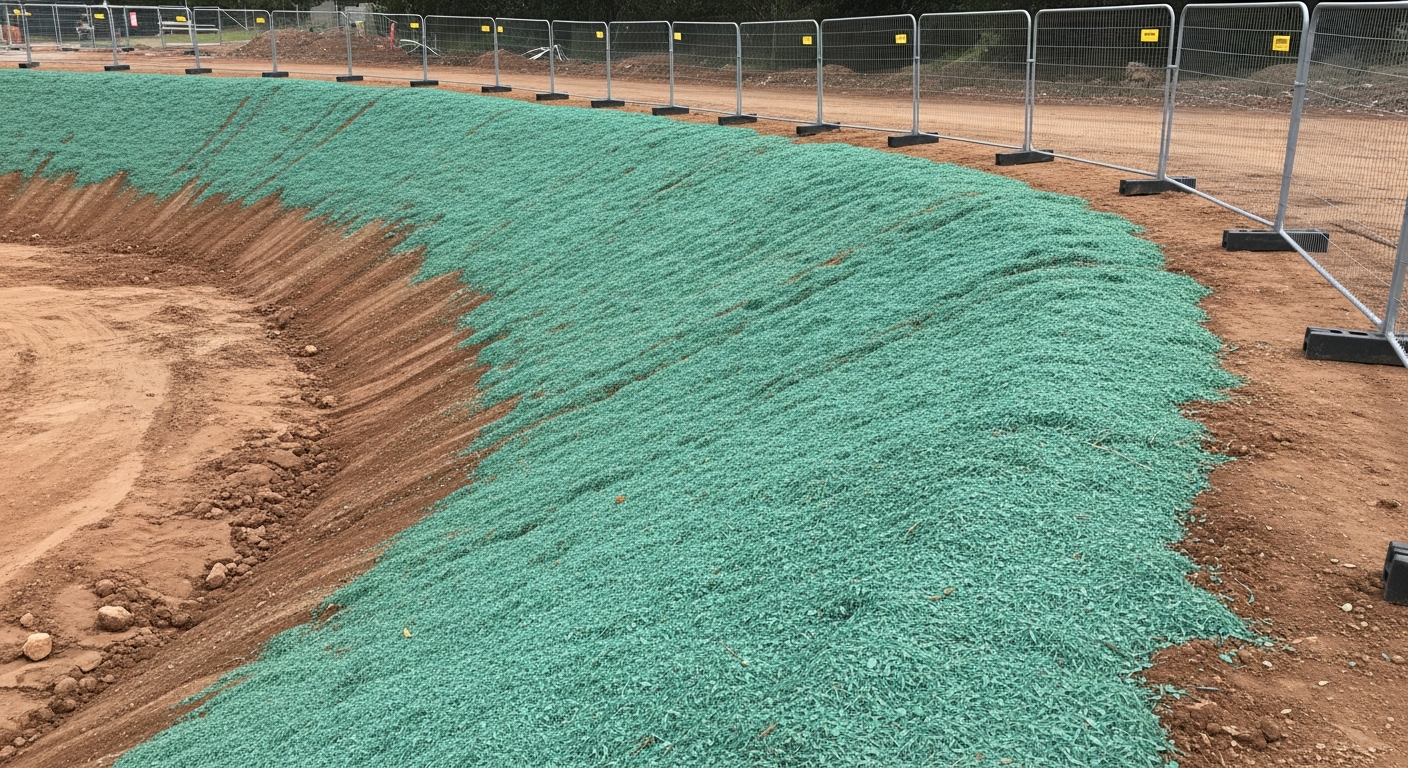
Bonded fiber matrix is the standard erosion control product specified on most commercial and civil hydroseeding projects in North Texas. Unlike standard wood or paper fiber mulch used on residential lawns, BFM contains bonding agents that cause the fibers to interlock and form a continuous mat over the soil surface — one that stays in place through significant rainfall events rather than washing off in the first storm.
For general contractors and developers in the DFW area, understanding when BFM is required versus when standard hydromulch is acceptable can affect both your budget and your compliance. Most permitted construction sites in Texas with slopes, drainage channels, or disturbed areas over a certain size will require BFM or an equivalent product as part of the stormwater management plan. Standard hydromulch on those areas will not pass inspection.
Work with a hydroseeding contractor who knows the difference, knows when each product is appropriate, and can provide the documentation needed to demonstrate compliance on your project.
Timing hydroseeding into your project schedule
On a commercial project, hydroseeding is one of the last site work items before a project is considered complete — but it cannot be the last thing thought about. Getting hydroseeding scheduled correctly requires coordination starting earlier in the process than most project managers expect.
The hydroseeding contractor needs to know the final grading completion date to schedule the application. They need to know whether irrigation is being installed before or after hydroseeding, since post-seeding irrigation installation can damage a fresh application. They need weather windows that give the application time to set before significant rainfall — especially important for BFM applications on slopes. And they need enough lead time to source the right seed mix and product for the project specifications.
On larger commercial projects in the DFW area, reaching out to your hydroseeding contractor during the grading phase — not after grading is complete — gives you the scheduling flexibility to hit your project completion dates without rushing the application or compromising results.
What large-scale hydroseeding equipment looks like
Commercial hydroseeding in the DFW area is done with truck-mounted or trailer-mounted hydroseeder units with tank capacities large enough to cover significant acreage per load. The larger the tank, the fewer refills required, and the more consistent the application density across a large site.
For very large commercial projects — subdivisions, highway work, large industrial sites — multiple units or multiple passes over consecutive days may be required. A contractor who is transparent about their equipment capacity and realistic about what they can cover in a single mobilization is a contractor you can build a schedule around. One who over-promises coverage rates and shows up with undersized equipment creates problems for everyone.
Seed selection on commercial projects
Commercial hydroseeding projects in North Texas use a wider range of seed types than standard residential lawn work. Depending on the project goals, you may be looking at warm-season turf mixes for common areas and landscaped grounds, native grass mixes for naturalized areas, roadsides, and habitat restoration, erosion control blends with fast-establishing species for slopes and disturbed areas, or overseeding mixes for temporary winter coverage on dormant warm-season turf.
The right seed for a commercial project is determined by the end use of the area, the sun and soil conditions, the maintenance expectations once the project is handed over, and in some cases the specifications written into the project plans. A commercial hydroseeding contractor should be able to work from your project specs and recommend the appropriate mix — not just apply a standard residential blend to everything.
How to evaluate a commercial hydroseeding contractor in DFW
Choosing the right hydroseeding subcontractor for a commercial project in North Texas comes down to a few key questions worth asking before you commit.
Have they worked on commercial projects comparable in scale and type to yours? A contractor with a strong residential track record is not automatically qualified for large commercial work. Ask for examples of similar projects they have completed in the DFW area.
Do they understand the product specifications on your project? If your plans call for BFM or specify a particular fiber content or application rate, the contractor should be able to confirm they use the right product and can provide documentation.
Can they meet your project timeline and coordinate with your schedule? Get a clear answer on lead time, mobilization date, and what they need from you to hit your completion target.
Are they responsive and easy to communicate with? On a commercial project, a hydroseeding subcontractor who is hard to reach or slow to respond creates schedule risk. Communication quality during the estimating process is usually a reliable indicator of how they will perform during the project.
Can they provide references from general contractors or developers they have worked with in Texas? Past performance on similar projects is the most reliable predictor of future results.
The bottom line for commercial clients
Commercial hydroseeding in the DFW area requires a contractor who understands the difference between showing up to spray a residential backyard and executing a compliant, on-schedule application on a permitted construction site. The right contractor brings the right equipment, the right products, the right documentation, and the right communication to keep your project moving.
If you are managing a commercial project and need hydroseeding that fits your schedule and meets your specs, the conversation starts with a site visit and a clear scope of work — not a price per square foot over the phone.

Managing a commercial project and need a reliable hydroseeding contractor?
Fox Hydroseeding LLC handles residential and commercial hydroseeding across the DFW area. Owner-operated, experienced with both standard hydromulch and bonded fiber matrix applications, and available to work directly with general contractors and developers from estimate through completion.
Get Your Free Project Estimate → foxhydroseeding.com/contact
Bring Your Property to Life With Expert Hydroseeding
Find Us On


Email address

Phone Number

